Small Orders Deserve Serious Safety Support: Notes from a Living Fence and a False Fire Alarm
I'll say something that makes some procurement people uncomfortable: a small order is not a reason to lower your service level. If anything, it's a reason to raise it. A first-time buyer with a six-person crew doesn't have a full-time safety director waiting in the next office. The person placing the order is often the same person who will have to look at a worker coughing and wonder if the spec was right.
I've been that person since 2017. For the last eight years, I've handled PPE and life-safety orders for a small industrial grounds maintenance contractor. I've personally made—and documented—14 significant mistakes that cost roughly $18,000 in wasted time, replacement gear, and lost client goodwill. Maybe it's 15; I'd have to open the spreadsheet. I keep that list because I don't want our team leads to repeat it.
Here's one lesson from the list: if you buy safety equipment like an afterthought, you'll get afterthought results.
A living fence was the hazard I didn't see coming
In April 2021, we took a job that looked like simple clearing. A client had a sixty-foot row of old arborvitae planted along their property line—the kind of thing people call a living fence. It acted as a boundary and a windbreak for years, until the lower branches died and the inside turned into decades of leaf mold, dry dust, and bird droppings.
I sent two workers with a stump grinder and masks that were not NIOSH-approved for that work. The box said dust mask. It was not a respirator.
When the grinder hit the dry interior, the air turned grey-brown. The crew made it through the morning, then one of them started coughing. Not a polite throat-clear cough—the kind that makes you stop and drink water. The other had a headache.
We stopped. The job fell two days behind. The client was understanding, but the extra paid hours and overnight shipping turned a small job into a money-loser. It wasn't the most expensive mistake on my list, but it was one of the dumbest. I still kick myself for not checking the box before we left. I assumed dust mask was good enough, because the task was a fence line, not a chemical plant.
What most people don't realize is that a living fence isn't just hedge clippings. It's a pile of biological material that has been decomposing for years. Disturbing it creates fine dust. Some of that dust is just dirt. Some of it can trigger allergies and inflammation.
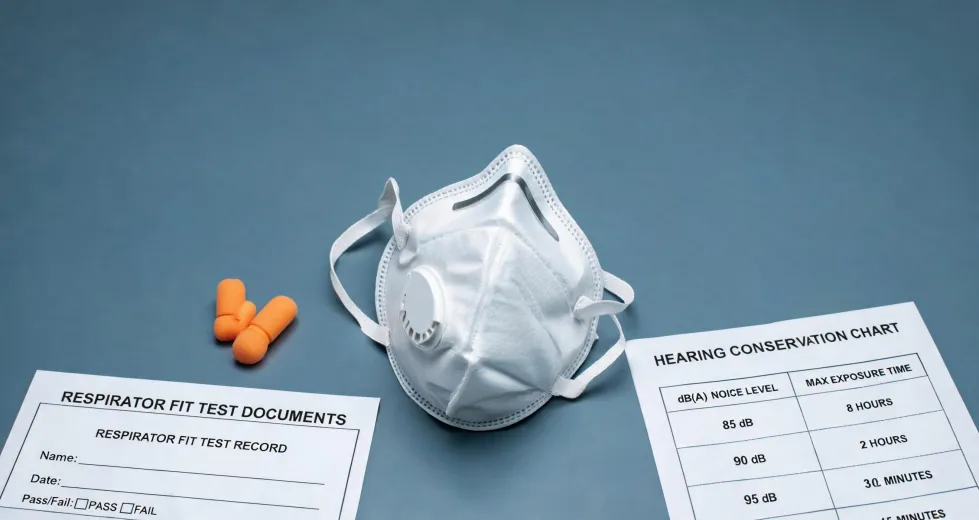
That afternoon, I typed moldex industrial respirators with valve into the search bar. I didn't know the brand's exact product line when I started. What I knew is that we needed something NIOSH-approved and cool enough to wear during heavy physical work. The valve matters more than most people think: it makes exhaling easier, which means a worker is more likely to keep the respirator on.
I specified Moldex N100 respirators for the dusty work after that. N100 doesn't mean 100% safe. It means the filter material is certified to capture at least 99.97% of the test particles used by NIOSH in non-oil environments. Because the dust along that fence line was dry and had no oil mist, N100 made sense.
Should mention: filter class only matters if the respirator fits. We set up formal fit-testing after that job, not because someone forced us, but because I finally understood that the most expensive respirator in the world does nothing if it leaks.
Why did my fire alarm randomly go off? I asked the right question too late
The second lesson came about three months later. Our shop fire alarm went off on a Tuesday night. No smoke, no heat, no reason I could find. The monitoring company called, then the volunteer fire department showed up. I remember standing in the parking lot at 11 p.m. looking at the fire extinguisher box on the wall and realizing I had no idea when it was last inspected.
The question I typed into my phone was exactly that: why did my fire alarm randomly go off?
The short answer is that most false alarms aren't random. That detector was old. It had been in service for at least 12 years, even though replacement around the ten-year mark is common guidance for smoke alarms. Dust had settled in the sensing chamber. It wasn't failing because it was haunted; it was failing because I treated it as a one-time install instead of a maintained system. NFPA 72 is a better reference on detector service life than my late-night guess.
After that, I called a local company. The search that finally mattered was fire extinguisher service near me. The technician found two extinguishers that were due for service. One had a gauge in the red zone. If a small fire had broken out, I would have grabbed a plastic tube full of hope.
Per NFPA 10, portable extinguishers need regular inspection and maintenance. The service company followed that standard. I didn't know enough at first to ask for it, and that wasn't an excuse.
Small orders are not small problems
Here's where I think the B2B safety market gets it backwards. We treat first-time or low-volume buyers like they should be grateful to receive a response. But a small buyer without a safety department is exactly the buyer who needs the supplier to ask questions: What are your people doing? What kind of dust or chemicals are they exposed to? Do they understand how to wear the equipment?
The vendor who sold me the first dust masks never asked any of those questions. The vendor who sold me the Moldex N100 respirators asked about the task, the presence of oil, fit-testing, storage, and whether we needed extra filters. That sales rep probably spent twenty minutes helping a $350 order. It was still the right way to sell.
I'm not saying every supplier must accept every tiny order. I understand why minimums and account minimums exist. But there's a difference between a minimum order quantity and an attitude. The attitude is what tells you that you're a burden.
When I was starting out, the vendors who took my $200 orders seriously are the ones I still use now that our annual safety budget is larger. Small doesn't mean unimportant. It means undeveloped potential.
The size of the PO doesn't change the size of the consequence
If you're responsible for a small crew, you don't have to know every standard in advance. You need suppliers who will tell you when you're about to buy the wrong thing. You need someone who asks what your people will actually wear and what they're doing. And you need to maintain things before there's an incident.
The next time an alarm goes off for no obvious cause, don't just silence it. Ask what it's telling you. Check the extinguishers. Check your filters. If someone treats a small order like a problem, find a better supplier.
I'll say it one more time: small orders deserve serious safety support. The size of the PO doesn't change the size of the consequence.

Maeve Callahan
Maeve Callahan is a head-protection analyst covering Type I and Type II hard hats, climbing-style safety helmets, bump caps, chin straps, suspensions, liners, and face-shield carriers. She applies ANSI Z89.1, EN 397, and EN 12492 criteria while comparing impact attenuation, penetration resistance, lateral deformation, electrical class, retention strength, field of vision, mass, fit range, and temperature conditioning. Her guides help EHS teams, contractors, utilities, and buyers select helmet systems for overhead hazards, work at height, electrical exposure, accessory compatibility, and worker acceptance.