Disposable N95 or Reusable Half Mask? The Moldex 7000 Series vs. Moldex N95, Compared Honestly
Here's a call I get more often than I'd like. It's 2 a.m., a smoke detector is beeping somewhere, somebody is Googling how to turn off a fire alarm, and by sunrise there will be a cleanup crew standing in a smoky room asking what they should wear. I'm usually the person they call next.
In my role coordinating safety equipment for industrial and commercial clients, I've processed more than 300 rush orders over the past decade, including same-day deliveries after small fires and spilled chemicals, plus one plant that needed respirators about 36 hours before an inspection and got them. The question I hear after the alarm goes quiet is almost always the same: should we buy disposable N95 masks or something reusable like the Moldex 7000 series half mask respirator?
I want to compare those two options honestly, not just on paper, but across filter choices, fit, cost over time, and the messy emergency scenario where a smoke detector did its job and now you're dealing with the aftermath.
What Are We Actually Comparing?
Let's clear up a common mix-up first. An N95 mask and a half mask respirator aren't two competing levels of protection in the same format. A Moldex N95 disposable is a complete single-use respirator: the filter material is the facepiece. The Moldex 7000 series half mask respirator is a reusable platform, and the level of protection depends on the filters installed. You can put N95 filters on it for ordinary dust, or switch to P100 filters when the exposure is oil-based, smoky, or otherwise more demanding.
Because of that, I'm not going to declare one winner in the first paragraph. The right answer changes with the worker, the hazard, and the number of hours involved. What I can do is lay out the differences that actually matter when you're buying.
Filter Ratings: The Number Isn't the Whole Story
Ratings come from NIOSH under 42 CFR Part 84. An N95 filter blocks at least 95% of test particles, and the N means it is not rated for oil-based aerosols. A P100 filter is 99.97% efficient and is tested with oil, so it works in both oil and non-oil particulate environments. Those are hard performance standards, not marketing terms.
It's tempting to look at the numbers and assume P100 is always better. But for simple dry dust, N95 is enough, and P100 filters usually add breathing resistance. Over-protection is a real problem: a worker who takes the respirator off to get some air is not being protected at all.
One quick correction before I go further: a P100 respirator isn't one specific product. It's any respirator fitted with P100 filters. If you search for a P100 respirator, you'll see disposables, half masks, and full-face pieces, which makes the term confusing. I'm comparing the disposable N95 route versus the reusable half mask route, with the P100 filter as the upgrade path when the hazard demands more protection.
Here's where the comparison gets interesting. With a disposable N95, you're locked into one rating. When the job changes, you cannot upgrade a disposable; you have to switch to a different product. With the Moldex 7000 series half mask, going from N95 to P100 means swapping the filter. Same facepiece, same seal, same fit. A half mask with P100 filters reaches the highest particulate filter efficiency available while staying lighter than most full-face options.
So the first conclusion is: the filter rating determines what you breathe, while the mask platform determines how long people can tolerate wearing it. A disposable N95 gives you one rating; a half mask treats the rating as an option.
Fit: Where the Right N95 Still Isn't Enough at Hour Five
Fit is where a lot of N95 purchases go wrong. A respirator that doesn't seal is a very expensive false sense of security. If you're shopping for disposables, the Moldex N95 mask size chart is a good starting point. The 2200, 2400, and 4600 series have different size profiles, and choosing the wrong one makes an already demanding day worse.
But even a correctly sized disposable mask has limits. It's shaped to your face at the moment you put it on. By hour five, the straps dig in, the nose area shifts, and the seal breaks. Workers start retightening it and unknowingly create new leak paths. I've watched this happen on job sites more times than I can count.
A reusable half mask addresses parts of that problem. The Moldex 7000 series half mask has a firmer shell and adjustable straps, so the seal doesn't depend on holding a soft folded mask against your face. It comes in different frame sizes, which means you're not trying to make a single shape fit an entire crew. Testers tell me the half mask feels bulkier at first, but after an hour or two, most prefer it over a disposable that keeps shifting with their jaw.
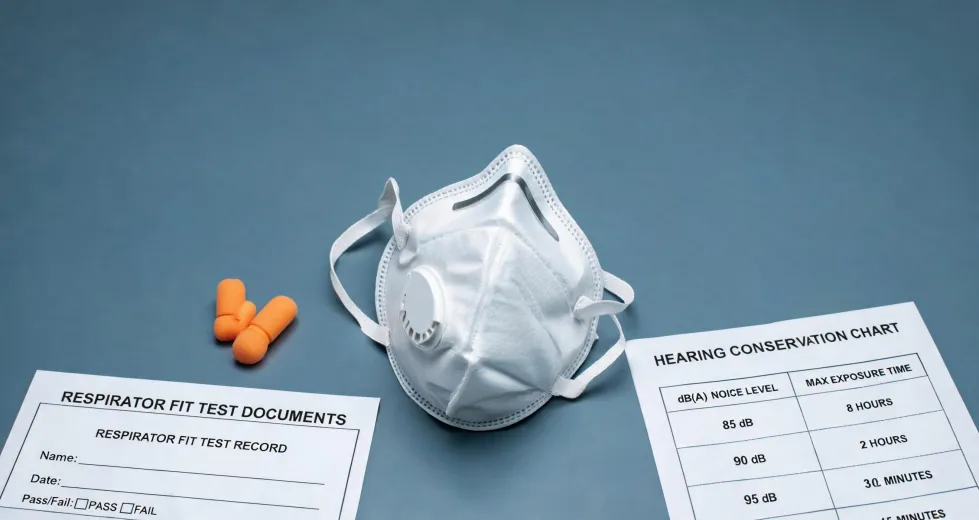
I should add a compliance note: none of this replaces a real fit test. OSHA's 29 CFR 1910.134 requires medical evaluation and fit testing when respirator use is required. The size chart helps you choose candidates, but the actual test decides who wears what.
The fit conclusion: for a short 30-minute task, a well-fitted disposable N95 is simple and effective. For sustained work, the half mask is more likely to keep its seal and stay comfortable.
Cost: The Math Most Buyers Skip
Now the part where money and habits collide. Small teams usually choose disposables because the price at the register looks friendlier. A box of 20 disposable N95s might run somewhere between $25 and $45, depending on model and distributor, as of early 2025. A reusable half mask facepiece might cost $15 to $30. Don't quote me on exact prices; my memory of distributor invoices isn't a price sheet. But the pattern holds.
The real comparison is cost per wear, not price per piece. Imagine a five-person crew doing dusty work several days a week. With disposables, each person can go through several masks in a week. Boxes disappear quickly. A half mask is bought once; filters are the ongoing cost. For particulate filters in a typical dry-dust environment, the filter is usually replaced when it's visibly contaminated, damaged, or harder to breathe through. Many of our customers get weeks of use from a pair of P100 filters before changing them. That logic doesn't apply to gas and vapor cartridges the same way, so check the manufacturer instructions and your safety professional before setting a change schedule.
The math shifts fast. One of our regular customers was spending more than $200 every six weeks on disposable N95s for a small crew. After moving to half masks with P100 filters, the total yearly cost went down, and they stopped throwing away an entire respirator just because the filter media was loaded. That's an anecdote, not a formal study, but I've seen the same pattern at several worksites.
Here's where I'll be openly opinionated: small orders deserve the same respect as big ones. When I was starting out, the vendors who treated my $200 orders seriously are the ones I still use for $20,000 orders. If you run a three-person shop and want to try two half masks before buying fifty, any supplier who dismisses you over quantity isn't a supplier, it's a gatekeeper. Small doesn't mean unimportant. It means potential.
The cost conclusion: for frequent, regular use, the reusable half mask is often cheaper within a few months. For occasional emergency use, a box of N95s is cheap insurance.
Emergency Scenario: Smoke Detector Goes Off. Now What?
Let me walk you through a pattern I saw often in 2024. A facility had a small electrical fire overnight. The smoke detector alerted people, the fire alarm did its job, and nobody was hurt. After the fire department cleared the building, the manager was left with soot on equipment, a smell of burnt plastic, and a cleanup crew scheduled for the same day. Someone also had to figure out how to turn off a fire alarm and reset the panel, but that procedure depends on the panel and alarm company. My part starts when someone asks what the crew should wear while cleaning up.
The manager wanted to hand out the N95s from the supply closet. I had to push back. Burning wire insulation leaves oil-based particles in smoke residue, and an N95 is not oil resistant. For soot cleanup, I would rather see workers in a half mask with P100 filters. A P100 respirator gives more margin in that situation and handles both oil and non-oil particles.
We supplied a dozen Moldex 7000 half masks with P100 filters on rush delivery to a site like this. Normal freight would have taken a few days; the client needed them that afternoon. We paid a courier fee and got them there by 4 p.m. The rush fee stung, but it was far cheaper than a stalled cleanup and the cost of people wearing ill-suited masks for days.
Let me be explicit about a boundary: I'm not suggesting anyone use an air-purifying respirator to enter an active fire. If the air is oxygen-deficient or the smoke is too thick, filters won't save you. That's SCBA territory. I'm not a fire safety engineer, so don't treat this as fire response advice. The point is simpler: after the smoke clears, somebody still has to do the dirty cleanup, and that task needs its own protection plan.
Which One Should You Actually Buy?
Here's a practical way to decide:
- If people only need masks for short tasks, occasional inspections, or emergency reserve, disposable N95s make sense. Use the Moldex N95 mask size chart and stock a couple of sizes so more faces can get a reasonable start.
- If workers wear respiratory protection for hours at a time, day after day, choose the reusable half mask. It costs more upfront and holds up better over a full shift.
- If the work involves oily particles, smoke residue, soot, or unknown contaminants, pick P100 filters. And if those jobs show up only sometimes, a half mask lets you stock both N95 and P100 filters for the same facepiece.
Don't let anyone pressure a small team into a bulk order before testing. Ordering a couple of half masks to try is not a waste; it's evaluation. Let employees wear them for part of a real shift and compare them with disposables. The respirator that still fits correctly at the end of the day is the one they'll actually use.
The Bottom Line
If I had to summarize this in one sentence: buy disposable N95 masks when the job is short and occasional, and buy the Moldex 7000 series half mask when respiratory protection becomes a regular part of the workday. Choose P100 filters when oil or smoke might be present; choose N95 filters when simple dust is the main concern. Having one facepiece that can handle both is a practical advantage.
I'm not an industrial hygienist and I'm not a compliance consultant, so treat this as a field perspective rather than a final safety decision. If respirators are required by your hazard assessment, OSHA's respiratory protection standard at 29 CFR 1910.134 requires a written program, medical evaluation, and fit testing. That's not optional paperwork; it's the system that makes any of these masks work.
The best respirator for your team is not the one with the biggest number on the box. It's the one that fits, stays on, gets maintained, and matches the actual hazard. Everything else, including brand and product line, matters only after those basics are right.

Maeve Callahan
Maeve Callahan is a head-protection analyst covering Type I and Type II hard hats, climbing-style safety helmets, bump caps, chin straps, suspensions, liners, and face-shield carriers. She applies ANSI Z89.1, EN 397, and EN 12492 criteria while comparing impact attenuation, penetration resistance, lateral deformation, electrical class, retention strength, field of vision, mass, fit range, and temperature conditioning. Her guides help EHS teams, contractors, utilities, and buyers select helmet systems for overhead hazards, work at height, electrical exposure, accessory compatibility, and worker acceptance.