Moldex PPE FAQ: Answers to Your Most Common Safety Questions
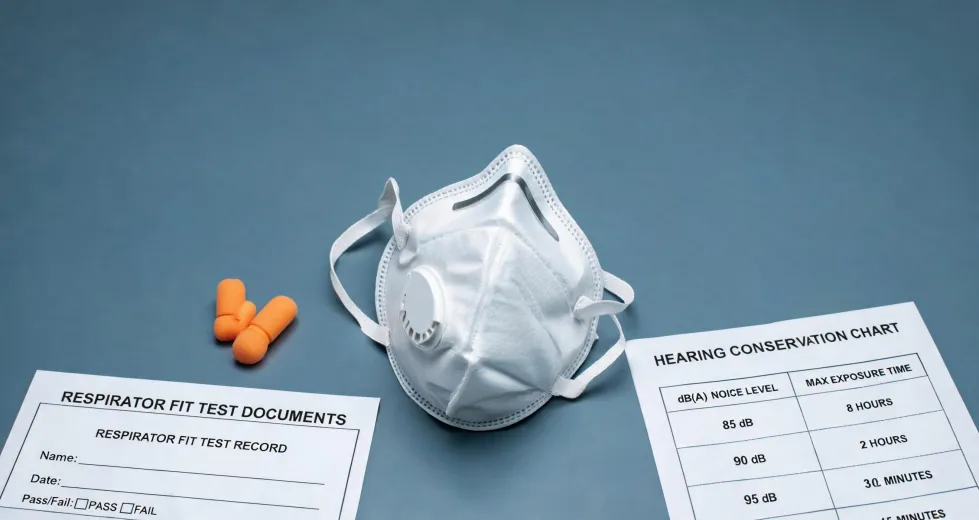
-
What does 'PPE' actually mean — and why does it matter?
-
How do loop earplugs work — and are Moldex earplugs any different?
-
What is the Moldex N95 2400 mask best used for?
-
Are Moldex industrial respirators NIOSH-approved?
-
What's the difference between N95, P100, and FFP2?
-
How do Moldex earplugs achieve NRR 33?
-
Can I wear Moldex hearing protection with other PPE like safety glasses?
-
What's the biggest mistake companies make when selecting respirators?
What does 'PPE' actually mean — and why does it matter?
PPE stands for Personal Protective Equipment. In industrial settings, it's the last line of defense between you and workplace hazards. OSHA requires employers to provide PPE when engineering controls aren't enough (that's federal regulation 29 CFR 1910.132, effective since 1994).
I've been handling safety equipment orders for about six years now — maybe seven, I'd have to check my start date. One thing I see over and over: people think 'buying PPE' is just picking a product off a shelf. It's not. You need the right PPE for the specific hazard. Respirators for airborne particles. Earplugs for noise. Safety glasses for impacts.
An informed customer asks better questions and makes faster decisions. That's why I'd rather spend 10 minutes explaining options than deal with mismatched expectations later.
How do loop earplugs work — and are Moldex earplugs any different?
Loop earplugs (the trendy consumer ones) use a reusable silicone stem with a small acoustic filter. They reduce sound by a fixed amount — typically 18 to 25 dB NRR. They're designed for concerts, sleeping, or focus, not for industrial noise environments where you might need 30+ dB reduction.
Moldex earplugs — like the SparkPlugs or Pura-Fit — work on the same basic physics: a foam form that expands to seal your ear canal. The difference is the Noise Reduction Rating. Our foam plugs typically achieve NRR 33, which is among the highest passive ratings available. Loop earplugs aren't NIOSH-rated for industrial use, so they shouldn't be your primary hearing protection on a job site.
One mistake I made early on? I ordered 500 pairs of stylish earplugs for a crew — thought 'any hearing protection is better than none.' The safety manager rejected the whole shipment because they weren't NIOSH-approved. That was a $890 lesson in reading spec sheets before buying.
What is the Moldex N95 2400 mask best used for?
The Moldex 2400 series (including the 2400 N95) is a disposable N95 respirator. It's NIOSH-approved under 42 CFR Part 84, meaning it filters at least 95% of airborne particles. I see these used most often in:
- Construction sites with dust and silica
- Healthcare environments (non-surgical, just particle protection)
- Manufacturing where fine powders are present
A common misconception: 'N95 stops all viruses.' It doesn't. N95 is a particulate filter — it doesn't protect against vapors, gases, or oil-based aerosols. For oil environments, you'd need P95 or P100. The 2400 is specifically for non-oil particulate. Don't stretch it beyond its intended use.
Are Moldex industrial respirators NIOSH-approved?
Yes. Every Moldex respirator sold in the U.S. carries NIOSH approval. The approval number is printed on the product — for example, the 2400 N95 has TC-84A-xxxx. You can verify it against the NIOSH Certified Equipment List (updated quarterly).
I once ordered a batch of 'NIOSH-approved' respirators from a third-party distributor. Checked the approval number — it was fake. Wasted roughly $450 on items that had to be returned. Lesson: buy direct from Moldex or an authorized distributor, or at least cross-check the NIOSH database before paying.
What's the difference between N95, P100, and FFP2?
Let me break it down simply — but I'll correct myself if I oversimplify.
- N95: Filters ≥95% of non-oil particles. NIOSH standard.
- P100: Filters ≥99.97% of all particles (including oil-based). NIOSH standard.
- FFP2: European standard (EN 149). Filters ≥94% of particles. Roughly equivalent to N95, but tested differently.
The 'N' in N95 stands for 'Not oil resistant.' The 'P' in P100 means 'Oil Proof.' So if your workplace has oil-based aerosols (like machining coolants), go P100. For general dust, N95 is fine. FFP2 is common in Europe; if you're exporting, that's what you need.
I learned this the hard way: we had a client in a metalworking shop. They ordered N95s because that's the number they knew. The filters clogged in hours from oil mist. We swapped them for P100s — problem solved. That mistake cost $320 in wasted N95s plus a production delay.
How do Moldex earplugs achieve NRR 33?
NRR (Noise Reduction Rating) is tested per ANSI S3.19. A higher NRR means more noise reduction — but real-world attenuation is usually less because of fit issues. Moldex SparkPlugs use a unique foam formulation that expands slowly and consistently, creating a better seal.
It's tempting to think 'higher NRR is always better.' That's a simplification. For moderate noise (85–90 dBA), NRR 33 might be overkill — you'd struggle to hear communication. OSHA requires that you not over-protect to the point of creating safety risks from missed alarms or shouts. Typical recommendation: derate the NRR by 50% per OSHA's 1983 guidance. So NRR 33 becomes about 16.5 dB effective. That's still strong protection for most industrial settings.
Can I wear Moldex hearing protection with other PPE like safety glasses?
Short answer: yes — but it depends on the fit. Over-ear earmuffs might interfere with safety glasses that have thick temples. In-ear earplugs (like Moldex foam plugs) work with virtually any glasses or face shield. The key is to test the combination before buying in bulk.
I once ordered 200 pairs of earmuffs for a team that wore safety glasses. The muffs' padding pressed the glasses' temple bars into their heads — painful after an hour. We ended up switching to earplugs and adding a communication headset for the loud areas. That was a $2,500 mistake (including the cost of returns and expedited reorder).
What's the biggest mistake companies make when selecting respirators?
Probably this: jumping to a product without doing a hazard assessment first. I see companies buy N95s for everything, or buy full-face respirators when half-mask would suffice. The result: money wasted, workers uncomfortable, protection inadequate.
Another one: ignoring the need for fit testing. A respirator only works if it seals. OSHA requires annual fit testing for tight-fitting respirators (29 CFR 1910.134). I've walked into a facility where everyone wore the same size mask — obviously not working. Fit test each individual. It's not optional.
This was accurate as of Q1 2025. Standards can change, so verify current OSHA requirements before implementing.

Maeve Callahan
Maeve Callahan is a head-protection analyst covering Type I and Type II hard hats, climbing-style safety helmets, bump caps, chin straps, suspensions, liners, and face-shield carriers. She applies ANSI Z89.1, EN 397, and EN 12492 criteria while comparing impact attenuation, penetration resistance, lateral deformation, electrical class, retention strength, field of vision, mass, fit range, and temperature conditioning. Her guides help EHS teams, contractors, utilities, and buyers select helmet systems for overhead hazards, work at height, electrical exposure, accessory compatibility, and worker acceptance.