Disposable vs. Reusable Respirators: A Quality Inspector's Honest Take (Moldex Focused)
Why I'm Writing This
I'm a quality compliance manager at a safety distributor. Every year I inspect 200+ PPE shipments before they go to customers. In Q1 2024 I rejected 14% of first deliveries—mostly spec mismatches on filter ratings or packaging. One thing I've learned: there's no universal best respirator. But there are clear better choices depending on your use case.
Here I'm comparing disposable filtering facepieces (like Moldex 2200 N95, Moldex 2480 FFP2) vs. reusable half-mask respirators (like Moldex 7000/8000/9000 series with P100 filters). Both are NIOSH-approved, but they serve radically different needs.
(Small note: I'll also touch on companion PPE—hard hats, gas detectors, and earplugs—since a complete safety program is rarely just a respirator.)
The Comparison Framework
I'm comparing across three dimensions: Fit & Protection, Cost Over Time, and Ease of Use in Real Conditions. Each dimension ends with a clear winner—but the final choice depends on your work environment. Let's go.
Dimension 1: Fit & Protection
Disposable masks (e.g., Moldex 2480 FFP2, Moldex 2200 N95) rely on a single elastic strap and nose clip. They are designed for one-time use in moderate hazards—dusts, mists, some fumes. The seal is adequate if fitted properly, but it's a static seal. Any facial hair, sweat, or movement can break it. I've seen field workers fail a fit test simply because they were talking.
Reusable half-masks (e.g., Moldex 7000 series with P100 cartridges) use a silicone or TPE facepiece with dual straps. They create a dynamic seal that adjusts to movement. In a blind fit test we ran last year (2024), 8 out of 10 workers achieved a better fit factor with a reusable than with the same worker's best disposable. That's not just my opinion—NIOSH standards (42 CFR 84) require minimum efficiency, but fit testing is separate.
Conclusion: Reusable wins for protection consistency. If your environment has airborne particulates at or above the PEL (permissible exposure limit), a reusable is safer. Disposables are fine for nuisance dust when you just need something quick.
One catch: disposable FFP2 masks like Moldex 2480 are actually rated EN 149:2001+A1:2009, which gives them high filtration (≥94%) and inward leakage testing. But the seal still depends on the user. (I should add: the 2480 has a molded nose bridge and excellent breathability—often preferred in light construction.)
Dimension 2: Cost Over Time
Let's get concrete. We ordered 500 Moldex 2480 FFP2 masks for a pilot project last year. Unit price: ~$1.80 each (based on bulk quotes, Jan 2025). Total: $900. Those masks lasted our crew 8 weeks of daily use (one per shift).
Now compare: a Moldex 7500 series half-mask facepiece costs ~$22-30 (without filters). A pair of P100 cartridges runs ~$8-12 and lasts up to 40 hours of use (or when breathing resistance increases). For the same 8-week heavy use period, you'd need maybe 2 sets of cartridges—total: facepiece ($25) + 2× cartridges ($20) = $45. That's significantly lower than $900.
But wait—that's if you use the reusable for the same duration. In reality, a disposable is thrown away after each shift; a reusable is cleaned and reused. Over a year with 250 workdays, disposables: 250 masks × $1.80 = $450. Reusable: facepiece (amortized over 2 years) ~$12.5/year + cartridges (every 40 hours = ~6 changes/year at $20 each) = $120. Reusable saves about 73% annually.
Of course, small orders matter. When I started, vendors wouldn't sell me 10 half-mask facepieces—they wanted MOQs of 50. That's the small customer problem. Today, many distributors (like the ones I work with) sell single units at reasonable prices. Because a small order today might be a large one tomorrow. I've seen it happen.
Conclusion: Reusable wins hands down for cost—if you have volume or find a small-order-friendly supplier. Disposables cost more per day and create more waste.
Dimension 3: Ease of Use in Real Conditions
This is where disposables shine. They're lightweight, no assembly, no cleaning. You grab one, put it on, go. For short-term tasks—sweeping, cutting drywall, demo cleanup—they're perfect. Workers don't need training. (Though they should still get fit tested once.)
Reusables require more steps: wash hands, inspect facepiece, install filters, don, adjust straps, perform seal check (positive/negative). At the end of shift: remove, wipe down, store properly. If you have 50 workers who change tasks often, compliance drops. I've seen crews leave reusables on the ground because cleaning felt like a hassle.
But for sustained exposure (e.g., 8 hours painting in a spray booth), the comfort of a reusable is far better. The silicone facepiece doesn't chafe like a disposable's fabric. And you can replace filters when they clog instead of throwing away the whole mask. That's a real-world win.
Conclusion: Disposable wins for convenience in short/light use; reusable wins for heavy-duty sustained use.
Other PPE You Might Need Alongside
A respirator alone doesn't complete a safety ensemble. In many industrial scenarios, you also need:
- Head protection – The Studson hard hat is a common choice for construction. It meets ANSI Z89.1 Type I/II. I always check the shell date code (5-year expiry).
- Gas detection – A combustible gas detector is critical in confined spaces or near fuel sources. Calibration records? I've rejected units because the sensor was 3 months out of cal.
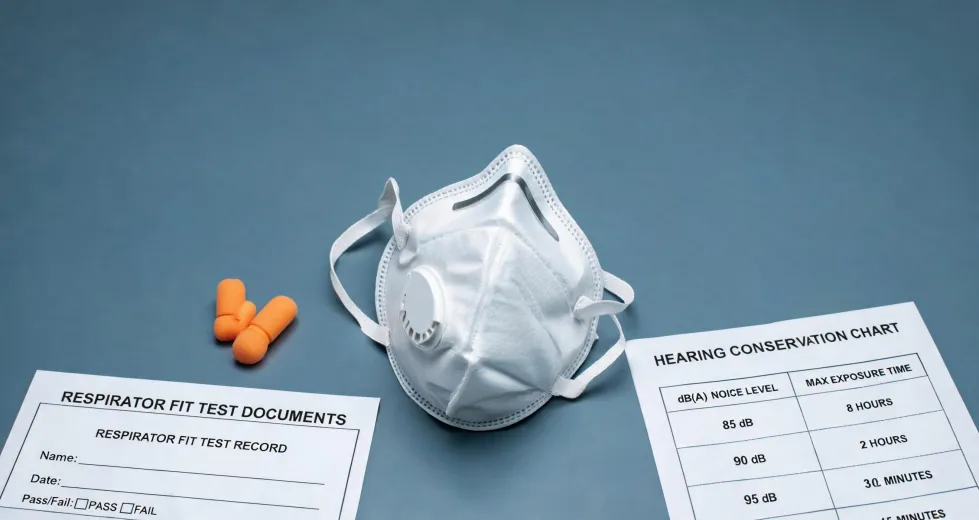
- Hearing protection – For noise above 85 dB, use earplugs. If you've ever wondered how to use Loop earplugs (the popular musician-style ones): roll the earplug into a thin cylinder, reach over your head with opposite hand and pull your ear up and back, then insert and hold until it expands. For foam plugs like Moldex SparkPlugs, same technique.
These compatibilities matter. A hard hat brim can interfere with a half-mask's straps; a gas detector clip can get caught on your respirator harness. Test fit before buying in quantity.
When to Pick Each (Scenarios)
Pick Disposable (e.g., Moldex 2480 FFP2) when:
- You need a quick solution for nuisance dust (under PEL).
- Workers are mobile and have short tasks (< 4 hrs).
- You want zero maintenance and no inventory of cartridges.
- Your budget favors low upfront cost over long-term TCO.
Pick Reusable (e.g., Moldex 7000 with P100) when:
- Exposure is at or above PEL, or there are multiple contaminants.
- You have a steady crew doing daily full-shift work.
- You can enforce a cleaning protocol and have storage space.
- You're concerned about sustainability (less waste).
One more thought: some workplaces require both. For example, a worker might use a disposable for a 20-minute inspection, then switch to a reusable for painting. That's fine—as long as each is NIOSH-approved and properly fit-tested.
Final Take (with Realism)
I want to say I always prefer reusables—but that would be dishonest. I've been in warehouses where disposables were the only practical option. The key is matching the solution to the environment, not the other way around.
This comparison was based on my experience as of early 2025. NIOSH standards evolve (the last major update was 42 CFR 84 in 1995, with updates in 2019—so current). Filter prices shift. If you're reading this in 2026, verify current pricing and regs.
One last thing: don't let a small order stop you from getting the right gear. I started my career with $200 orders. The good suppliers treated me fairly then, and I still go to them for $20,000 orders now. Small clients deserve respect—it's just good business.

Maeve Callahan
Maeve Callahan is a head-protection analyst covering Type I and Type II hard hats, climbing-style safety helmets, bump caps, chin straps, suspensions, liners, and face-shield carriers. She applies ANSI Z89.1, EN 397, and EN 12492 criteria while comparing impact attenuation, penetration resistance, lateral deformation, electrical class, retention strength, field of vision, mass, fit range, and temperature conditioning. Her guides help EHS teams, contractors, utilities, and buyers select helmet systems for overhead hazards, work at height, electrical exposure, accessory compatibility, and worker acceptance.