Hard Hat vs Safety Helmet: What Sourcing PPE for Ranch and Welding Crews Taught Me
In March 2024, I got a call from a ranch manager in west Texas who needed 40 units of head protection in five days. His crew was a week away from cattle fence line repairs and a backlog of welding projects that had already been postponed twice. The old hard hats hadn't made it through the previous season (cracked suspensions, a few too many encounters with grinder sparks).
Five days isn't the tightest deadline we've ever worked with. We've done same-day turnarounds for mining clients and 48-hour full-PPE packages for contractors facing penalty clauses. But it was tight enough that I couldn't just grab whatever the distributor had on the shelf. So I asked what the crew would actually be doing, hour by hour.
The answer was: fence repair in the mornings, welding equipment repair in the afternoons. Two very different hazard profiles on the same shift. And then he asked the question I've been hearing more and more since about 2023: "Should we just get the safety helmets? They look like the better product."
It took me the better part of a decade and a few hundred PPE orders to understand that the right answer isn't a simple yes.
How I Compare Head Protection
I'm not here to argue that one brand of hard hat beats another. What I compare is the two broad approaches on the market today: traditional hard hats (typically ANSI Type 1) and modern safety helmets (typically ANSI Type 2 with chin straps).
The framework I use is practical, not theoretical. I look at four dimensions:
- Protection scope – what impacts each one actually covers
- Wearability – what happens after hour six on a hot day
- Compatibility with the rest of the PPE you're already wearing
- Real cost over a year, not just the sticker price
If you've ever returned from a job site and found head protection sitting on a pickup dashboard, you already know why wearability is on the list.
Protection Scope: Type 1 vs Type 2
This is where safety helmets dominate, at least on paper. ANSI/ISEA Z89.1-2019, which OSHA's head protection standard (29 CFR 1910.135) references, splits industrial head protection into two types. Type 1 protects against impacts to the top of the head. Type 2 adds protection against lateral, front, and rear impacts. Most traditional hard hats are Type 1. Most of the newer helmet-style units are Type 2.
Go back to that ranch crew. On the fence line, the main overhead risk is a dropped T-post or a branch—top impact. Type 1 covers that scenario. But in the welding area, there's a second level of risk: someone working under a raised platform, a crew member passing overhead, a scaffold plank shifting. A lateral hit from a falling tool isn't rare in that environment. That's where Type 2 makes a measurable difference in protection, not just in marketing copy.
From the outside, a $150 safety helmet looks like a $15 hard hat with extra plastic. The reality is the protection philosophy is different: the shell, the suspension, the strap, the accessory rails—they're built around a different set of hazards.
"A safety helmet's lateral coverage isn't a luxury upgrade. It's a different level of protection."
If I could push one point into every buyer's head, that's the one. But it comes with a catch, and the catch is the reason I've started pushing back on the "just get the helmets" advice.
Wearability: The Metric Most Buyers Skip
Most buyers focus on the shell material and the price, and completely miss how the unit behaves after hour six on a hot day. Let me give you the numbers I've seen.
The heaviest safety helmet I've sourced recently runs around 420 grams. A standard hard hat is closer to 300-350 grams (at least in the quotes from early 2025—that may have shifted). That's a 20-30% difference on the scale. On a 10-hour shift in August, with workers bending over fence wire, looking up at welds, and leaning into a grinder, the difference is more than numbers.
Here's what surprised me when I started tracking actual usage patterns: the chin strap. On paper, it's the safest component of a helmet-style unit. In practice, crews that have never worn one will loosen it, tuck it, or take the whole unit off during the middle of the day. I don't have hard data on industry-wide abandonment rates for chinstrap-style helmets. What I can say anecdotally: across the last four ranch operations we supplied, roughly 60% of workers who had never used a safety helmet grabbed the traditional hard hat from the shared bin by week two. Not because the helmet was unsafe, but because the strap was a nightly adjustment they weren't used to making.
Seeing helmet-style units and traditional hard hats side by side over a full season made me realize that the most important safety spec on a jobsite is whether the gear fits the habits of the people wearing it. The best head protection in the world is worthless if it ends up on the dashboard. A Type 1 hard hat that's actually worn is safer than a Type 2 helmet that's left in the truck because it's "too fussy." That's not a popular thing to say in a market that's pushing everyone toward helmets, but it's what I see on real sites.
Compatibility With Welding PPE, Respirators, and Earplugs
This is the dimension that most comparison articles miss, and it's the one that actually shows up in my order data. A welding crew isn't wearing only head protection. There's a welding hood, grinding shield, ear protection, and often a respirator underneath.
Modern safety helmets have accessory rails that make it easier to attach earmuffs and faceshields cleanly. Traditional hard hats have slots too, but the mounting systems vary more between brands, which creates gaps you don't want when grinding sparks are flying. When a client asks me to put together a welding safety equipment package, I usually recommend a helmet-style unit for the welding side of the operation if the budget allows.
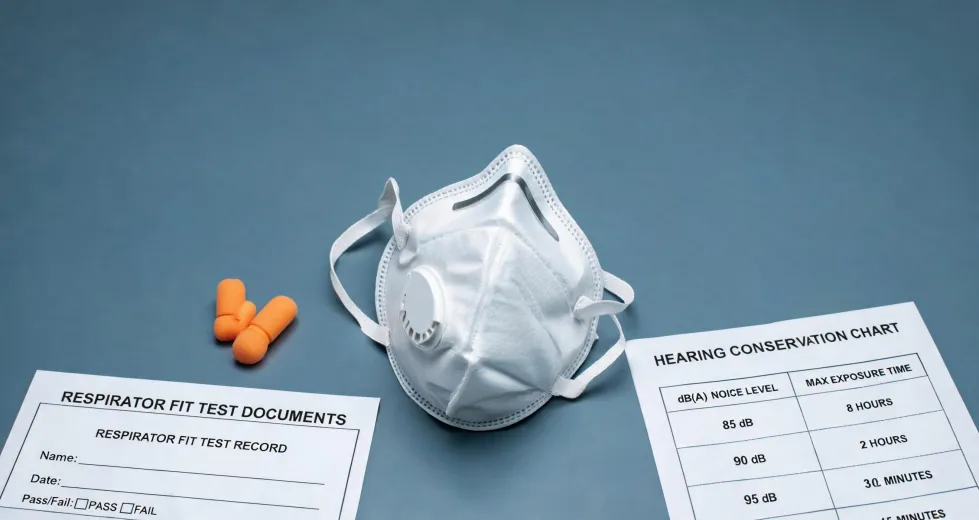
Hearing protection is the part that gets underweighted. Welding and grinding push 90-105 dB depending on the task. We include Moldex earplugs in every welding kit we ship—usually Pura-Fit or Rockets, both rated NRR 33, which is the highest we stock. They fit comfortably under either a hard hat or a safety helmet. That part is easy.
The tricky part is respiratory protection. For moderate welding fume exposure, a Moldex N95 particulate respirator mask, like our 4600 series, handles the job. But here's the interaction problem I've seen trip up purchasing departments: when a worker pulls a safety helmet's chin strap tight over a half-mask respirator, it shifts the respirator's seal. Every time they bend down to check a weld, the strap upsets the mask. They re-seat it, and by mid-afternoon they've given up on one of the two.
That's a real-world compatibility issue. It took me about 150 orders to realize this is why welding crews often prefer the traditional hard hat without a chin strap: it leaves the respirator seal alone. For heavier fume loads, we supply the Moldex M7000 half-mask respirator, which seals well but adds even more bulk below the face. I always tell clients to test the combination—helmet, chinstrap, respirator—before buying 40 of each.
And let's be honest about image too. When I helped one mining client upgrade from standard hard hats to helmet-style units back in 2023, the site supervisor told me the crews finally looked like professionals. Client feedback improved noticeably, and not just about the gear—about the whole operation. The quality of what you put on your workers' heads sends a signal about how seriously you take safety.
Cost Over a Year, Not Just a Quarter
Now the spreadsheet part. Based on quotes we received from major safety distributors in early 2025 (verify current pricing—it moves):
- Traditional hard hats: roughly $12-30 per unit
- Safety helmets with Type 2 rating and chin strap: roughly $50-150 per unit
The sticker gap is obvious. But total cost of ownership narrows it. Hard hats degrade under UV, heat, and repeated impacts, and most manufacturers recommend replacement every 2-5 years. The polycarbonate safety helmets we carry have generally lasted longer in the ranch crews we track—not because the material is magically better, but because the suspension is easier to clean and the shell doesn't absorb sweat the same way.
Here's where I land after watching this for years: for a mobile crew that's spread out over fencelines and pasture, the "cheaper" hard hat is often the better economic choice, precisely because it's the thing they'll actually wear. For a fixed industrial crew with infrastructure to train people on chinstrap use, the safety helmet's higher price gets amortized over years of real, continuous wear. It's not about which category is better. It's about which one matches the routine.
So Which One Should You Order?
If you're placing an order this month, here's how I'd decide.
Choose a traditional hard hat if:
- Your crew is mobile or outdoors (fence repair, cattle handling, equipment maintenance across multiple sites)
- Workers haven't been trained on chinstrap-style units yet
- Workers regularly wear half-mask respirators or N95 masks under their head protection
- Budget is a hard constraint and you already have a replacement cycle in place
Choose a safety helmet if:
- Your crew works in a fixed industrial or welding environment with overhead work
- Workers already use chinstraps or climbing-style harnesses
- You need integrated accessory rails for earmuffs, faceshields, or headlamps
- You can commit to training so the chinstrap actually gets used
And remember: head protection is just the start. In the rush orders I handle, the most common additions after head protection are hearing protection (Moldex earplugs are my default), respiratory protection for welding fumes (N95 for moderate exposure, half-mask for heavier), and safety glasses that don't fog under a grinding shield.
I'm not a biomechanics researcher, so I can't speak to the laboratory test data on impact absorption. What I can tell you from the procurement side: the best head protection is the one that's still on your workers' heads at the end of the shift. Ask them which one that will be.

Jane Smith
I’m Jane Smith, a senior content writer with over 15 years of experience in the packaging and printing industry. I specialize in writing about the latest trends, technologies, and best practices in packaging design, sustainability, and printing techniques. My goal is to help businesses understand complex printing processes and design solutions that enhance both product packaging and brand visibility.