You’re Probably Not Getting the Protection You Think You Are
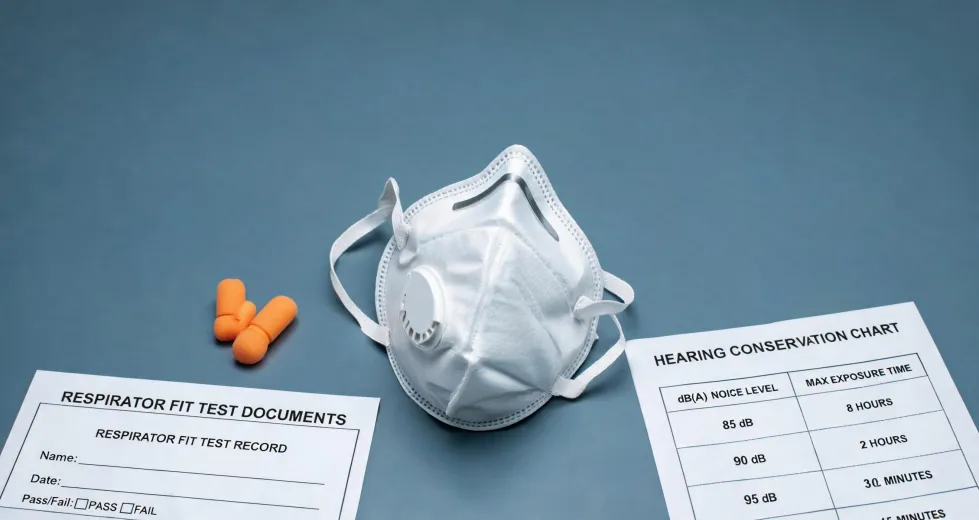
You Think an N95 Is Enough. It Might Not Be.
I got a call last September from a plant manager—let's call him a guy I’d worked with before. He had 150 workers spraying polyurethane coatings in a warehouse that was being converted into a cold storage facility.
He asked for “N95s, the usual.”
I asked what exactly they were spraying. He wasn’t sure. “It’s not that bad,” he said. “We just need something for the dust.”
That’s the moment that still makes me cringe. Because if I’d just sent 150 boxes of Moldex 2200 N95 masks without asking more questions, he would have gotten a false sense of security.
The reality? Organic solvents plus fine particulates. An N95 won’t stop the vapors. What he actually needed was a half-face respirator with a combination cartridge like the Moldex 8000 series with a P100 plus organic vapor filter. Different product. Different protection class. Different price.
It’s tempting to think “an N95 is an N95.” But that’s the kind of oversimplification that gets people in trouble.
The Real Problem: Three Assumptions That Fail
After eight years of specifying PPE for industrial clients—everything from chemical plants to food processing—I’ve noticed a pattern. Safety managers tend to make three assumptions that are, frankly, dangerous.
1. “One Mask Fits the Job”
People grab a Moldex N95 mask or a pool fence approach to PPE: one barrier, all threats. But industrial protection isn’t a fence. It’s a set of sieves.
An N95—even a NIOSH-approved one like the Moldex 2200 NIOSH N95—stops about 95% of airborne particles above a certain size. That’s great for dust, pollen, and some bioaerosols. It’s useless for gases, vapors, and very fine oil-based particulates.
If you’re in an environment with welding fumes, solvent vapors, or pesticide mists, an N95 is essentially a placebo. You need a different class of protection—like a half-mask or full-face respirator with appropriate cartridges.
(Side comment: It’s ironic—we spend a fortune on galvanized steel fence for physical perimeter security, but we’ll cheap out on the one thing that actually enters your body.)
2. “NIOSH Approval Means It Works for Everything”
This is one of the most persistent myths I run into. People see “NIOSH approved” on a box—say, a Moldex 2200 NIOSH N95—and they think it’s a universal seal of safety.
That’s like saying a car is safe because it has seatbelts, ignoring that you need airbags, crumple zones, and anti-lock brakes for full protection. NIOSH tests N95 masks for particulate filtration efficiency under specific conditions. It doesn’t test for chemical resistance, fit under different face shapes, or performance at high temperatures.
This was true 15 years ago when digital options were limited. Today, online platforms have largely closed that gap. We can now compare what is better than pepper spray for specific threats—and it’s the same with respiratory protection: the question isn’t “is it NIOSH approved?” but “is it the right NIOSH-approved product for this specific hazard?”
3. “If It Fits, It Protects”
I still kick myself for not testing fit more rigorously back in 2019. We supplied a construction crew with what I thought was the right half-mask respirator. They passed the user seal check—barely. But the Moldex N95 mask I’d chosen didn’t account for the fact that half the crew had heavy beards or high cheekbones.
After the third week, three workers got sick from inhaling silica dust. Not badly—but enough to trigger an OSHA recordable, an investigation, and a $12,000 fine for inadequate respiratory protection.
Fit testing is not optional. Even the best respirator fails if it leaks around the face.
The Cost of Getting It Wrong
Let’s talk about what happens when you buy the wrong mask.
Health costs: A single case of occupational asthma, silicosis, or chemical pneumonitis can cost $50,000 to $250,000 in medical treatment, lost work, and litigation. That’s per worker.
Regulatory costs: OSHA fines for respiratory violations can hit $13,653 per violation (per the 2024 penalty adjustment). A multi-worker violation adds up fast.
Hidden costs: Morale drops. Workers distrust the safety program. You lose experienced people. And every time you buy the wrong product, you waste money—not just on the masks themselves, but on shipping, storage, and disposal of things that never got used.
I’d argue the biggest hidden cost is the false security. A worker who thinks they’re protected when they’re not is more likely to take dangerous risks.
What I Actually Do Now
I don’t recommend products based on what I think is “good enough.” I match the hazard to the protection class. Here’s a quick framework:
- Identify the hazard. Is it a particle? Gas? Vapor? Biohazard? Use an SDS and workplace monitoring data—not intuition.
- Pick the right class. N95 for nuisance dust. P100 for fine particulates and oils. Half-mask or full-face with cartridges for chemicals.
- Verify fit. Make every worker pass a quantitative fit test. If it doesn’t fit, it doesn’t protect.
- Think about the ecosystem. Does the worker need hearing protection too? Can the respirator be worn with safety glasses? Look for compatible PPE—like Moldex offers masks designed to work with goggles and hearing bands.
That’s it. Four steps. No magic, no shortcuts.
If you’re dealing with a situation where you think an N95 might not be enough, I’m not going to sell you something you don’t need. But I will ask the hard questions—because I’ve seen what happens when the easy answer fails.
And honestly? A client who realizes halfway through a project they’ve been breathing methanolic vapors through a paper mask? That’s a call I never want to take again.

Maeve Callahan
Maeve Callahan is a head-protection analyst covering Type I and Type II hard hats, climbing-style safety helmets, bump caps, chin straps, suspensions, liners, and face-shield carriers. She applies ANSI Z89.1, EN 397, and EN 12492 criteria while comparing impact attenuation, penetration resistance, lateral deformation, electrical class, retention strength, field of vision, mass, fit range, and temperature conditioning. Her guides help EHS teams, contractors, utilities, and buyers select helmet systems for overhead hazards, work at height, electrical exposure, accessory compatibility, and worker acceptance.