Safety Purchasing Is Risk Management. A Random Fire Alarm Taught Me That.
Here’s the opinion I’ve formed over five years of ordering safety supplies for a 180-person facility: buying safety equipment isn’t a purchasing task. It’s a risk-management task. If you treat it like a routine buying decision, you’re going to end up paying for your own lesson—often more than once.
I’m the office administrator here, which means I manage everything from printer toner to PPE. In an average year I place 60–80 orders across maybe eight vendors, and I report to both operations and finance. I’m not a safety engineer. But I learned that the order form is where prevention actually happens—or where it fails.
Why Did My Fire Alarm Randomly Go Off Then Stop? (The Incident That Started It)
Two months ago, our building’s fire alarm randomly went off then stopped. Just… stopped. It was 2:40 on a Thursday; the whole production floor emptied into the parking lot for forty-five minutes. The fire department checked everything. No fire, no smoke, no explanation.
A week later, it happened again. Same alarm. Same annoyed employees. This time the maintenance tech found it: a smoke detector with a failing backup battery, sending intermittent signals as it died. The detector was eight years old. Its replacement date had passed two years earlier. A ten-minute annual check would have caught it.
Nobody cut corners on purpose. It just wasn’t on anyone’s list. That’s the thing about prevention—it doesn’t feel urgent until the day it should have happened.
The Rookie Mistake That Cost $800
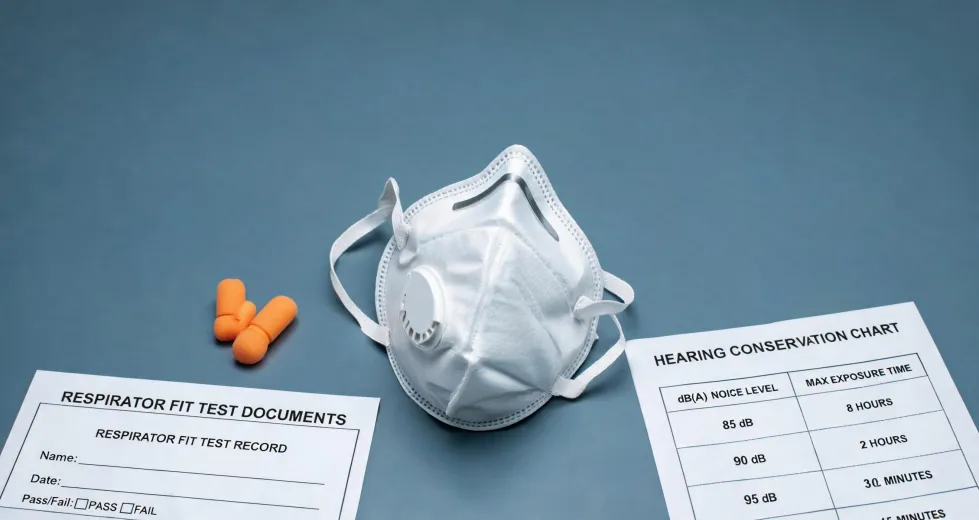
I used to assume that a product labeled “safety” was, well, safe. My first year in this role, I ordered a budget box of N95-looking masks from a distributor I hadn’t vetted. The listing said N95. The price was right. The masks arrived with no NIOSH approval markings whatsoever—no TC number, no manufacturer logo. We couldn’t legally use them for the sanding and grinding tasks we’d bought them for. I ate the roughly $800 cost out of the department budget, and the safety manager stopped trusting my work for a while. (Fair, honestly.)
That was my lesson: the certification is the product. Everything else—the filter efficiency, the fit, the comfort—sits on top of that approval. If the approval isn’t there, you’ve bought nothing but expensive dust.
Now when I requisition respirators, I start with the NIOSH approval list. The Moldex N95 mask—the 2200 series we stock—shows up there, and its approval documentation is easy to pull, which matters when your finance team asks questions. The shell also holds its shape in our humid shop conditions, where softer masks go limp after an hour. I didn’t anticipate caring about that. Humidity doesn’t show up on a spec sheet.
Hearing Protection: The NRR 33 That Nobody Wore
I applied the same logic to hearing protection and almost made the opposite mistake. I got a great price on a box of foam earplugs with a decent NRR rating. They were cheap. They were approved. And the crew hated them.
Foam that’s too stiff, or too thick, or uncomfortable past an hour—people stop wearing it. Hearing protection that sits in a drawer has an NRR of zero, mathematically speaking.
We switched to Moldex Pura-Fit foam earplugs (NRR 33). They’re green, tapered, and look a little odd at first glance. I was skeptical, if I’m honest. But the shop floor got a test box, wore them for two weeks, and asked to keep them. NRR 33 is among the highest ratings you’ll see for foam earplugs, the 100-pair box keeps our per-day cost low, and—most importantly—the crew actually uses them. Compliance is part of prevention.
The best protective product in the catalog does nothing if it never gets worn. Prevention requires cooperation.
Deck Railing, Leather Welding Gloves, and the Same Lesson Repeated
Here’s what surprised me: this pattern shows up in every category, not just PPE. The same week we finalized the earplug switch, I got requisitions for leather welding gloves for the maintenance shop and a deck railing replacement for the loading dock. Three unrelated items. Same underlying question: who verified the standard?
Leather welding gloves come with claims about heat and cut resistance. The cheapest quote I got was 40% below everyone else—and it contained zero test data. No standard cited, no rating, nothing. (Not that I expected a glossy PDF, but a man can dream.) The gloves we eventually ordered had clear ANSI ratings, and the vendor could actually explain what those ratings meant.
The deck railing was a different kind of lesson. County building codes and OSHA guardrail requirements exist regardless of whether I can recite them from memory. The first contractor asked why I cared so much about load ratings; it’s “just a railing.” I’ve learned that people who tell you standards don’t matter are usually the people who don’t want to meet them.
More often than not, it comes back to the same rule. Check the label. Verify the standard. Get it in writing.
What About the Cost?
I usually hear one objection at this point: “Premium PPE costs more.” Yes. The Pura-Fit plugs cost more per pair than the no-name foam. The Moldex N95s aren’t the cheapest masks on the market, either. And the gloves with test data cost more than the gloves with a promise.
Here’s the math that changed my mind:
- A failed safety order means reordering, expedited shipping, and downtime. That bill usually exceeds the original “savings.”
- An unapproved product can lead to an OSHA citation, a doctor’s visit, or a compensation claim. That invoice isn’t measured in line items.
- An uncomfortable control that nobody wears means the exposure continues. You get to buy the next solution while the clock is still running.
And the vendor who can’t provide proper documentation? I learned that lesson separately. A supplier once sent us a handwritten receipt in the mail; finance rejected the whole expense, and the $1,800 order came out of our department budget. The invoice arrived via USPS—$0.73 in postage (First-Class Mail, 1 ounce, per the January 2025 rate table at usps.com). I’ve spent more on coffee in poorer taste.
Besides, the FTC already settled this question: advertising claims have to be truthful and substantiated. That’s not an opinion, it’s guidance at ftc.gov. I’d rather verify before I buy than argue afterward.
My Actual Checklist
This is what the fire alarm, the failed mask order, and the NRR 33 debacle all distilled into:
- Find the applicable standard before you search for products.
- Verify the certification exists—and that the vendor can actually show it.
- Test the product with the people who’ll use it.
- Replace or re-check before the failure date, not after.
It’s not glamorous. It saves money anyway.
Prevention Is the Efficient Choice
I still think about that fire alarm. Someone skipped the annual detector check. Not out of malice—it just became a low-priority task, and low-priority tasks get deferred until they become a 2:40 PM evacuation.
From my perspective, prevention isn’t the cautious path. It’s the economical one. Checking a certification takes five minutes. Testing a product with your crew takes two weeks. Replacing a battery takes a ladder. All of it is cheap. The alternative—learning by failure—is costly, embarrassing, and entirely avoidable.
Five minutes of verification beats five days of correction.
Check the standard. Verify the claim. Buy it right the first time.
That’s not just PPE advice. It’s the whole job.

Maeve Callahan
Maeve Callahan is a head-protection analyst covering Type I and Type II hard hats, climbing-style safety helmets, bump caps, chin straps, suspensions, liners, and face-shield carriers. She applies ANSI Z89.1, EN 397, and EN 12492 criteria while comparing impact attenuation, penetration resistance, lateral deformation, electrical class, retention strength, field of vision, mass, fit range, and temperature conditioning. Her guides help EHS teams, contractors, utilities, and buyers select helmet systems for overhead hazards, work at height, electrical exposure, accessory compatibility, and worker acceptance.