I Buy PPE for a Living: A Checklist for Moldex N100, Earplugs, Fire Extinguisher Cabinets & Workwear
-
Step 1: Identify the Work, Not Just the Product Name
-
Step 2: Check Labels Rather Than Legends
-
Step 3: Calculate Cost per Worker-Day, Not Cost per Box
-
Step 4: Test Samples With Actual Workers Before Committing
-
Step 5: Include Installation and Access in Fire Extinguisher Cabinet Purchases
-
Step 6: A 'Workwear Jacket' Is Not a Specification
-
Step 7: Schedule an Annual Compliance Review
-
Common Mistakes I Still See on Purchase Orders
I'm the procurement manager at a 340-person metal fabrication plant. I've owned our PPE and safety equipment budget for eight years—about $180,000 a year at current levels, and over $1.2 million in tracked invoices since 2017. That history changed how I look at a purchase order.
If you're responsible for buying safety products at a small or mid-size plant, this checklist is for you. I use it for respirators, hearing protection, fire extinguisher cabinets, and workwear. It's not a full safety manual, and it never replaces a qualified industrial hygienist or safety supervisor. It simply stops me from making the same expensive mistake twice.
Step 1: Identify the Work, Not Just the Product Name
A purchase request that says 'one box of masks' is incomplete. I used to accept that and move on. Now I ask what task the worker will do while wearing the item. Sanding, solvent wiping, spray painting, grinding, and welding are not the same exposure. The department name stays the same, but the work changes.
In March 2023, our maintenance crew asked me to reorder respirators that had been on the same SKU for two years. What I didn't know at first: they had started using an epoxy coating that released isocyanate vapors. A particulate mask is the wrong tool, no matter the filter efficiency. We stopped the order and got a proper exposure assessment. That is the moment I learned to write 'task plus material plus duration' on every request, no exceptions.
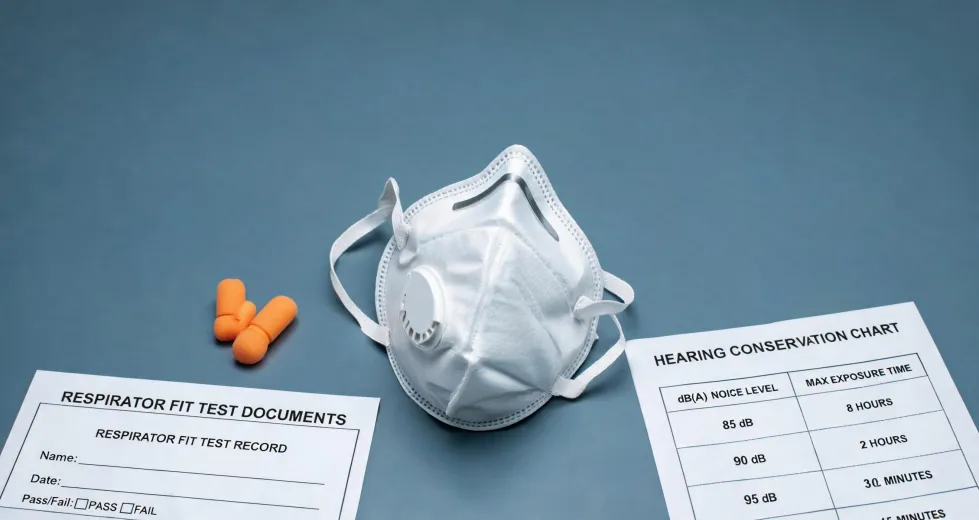
If the assessment shows only airborne particles, filter class matters. NIOSH divides particulate respirators into N, R, and P series under 42 CFR Part 84. The 'N' means not oil resistant; the '100' means it filters at least 99.97% of the test particles. Our plant uses Moldex N100 respirators when the spec really calls for N100 class protection. I verify the approval by the TC number printed on the product, not by the color or the marketing copy.
Step 2: Check Labels Rather Than Legends
A product name can tell you the intended market, but it does not tell you the measured performance. I learned this in procurement, not in a safety class. Someone in our office recently asked me, 'is body armor drink good for you?' I said I'm not a nutritionist, but if I were buying it, I'd read the nutrition label before trusting the word 'armor.' PPE is exactly the same.
For earplugs, the label should show an NRR. The highest number is not always the right number; you need protection that fits the actual noise level and still lets workers hear instructions and warning signals. When our noise assessment pointed to high attenuation, we chose Moldex 6800 earplugs with an NRR of 33. Since earplugs only work when they're worn correctly, tested comfort and fit matter more than the color of the foam.
Step 3: Calculate Cost per Worker-Day, Not Cost per Box
The conventional wisdom in procurement is to compare price per piece and select the lowest. In my experience, that logic works for paper clips and fails for anything worn by a human. If an earplug is uncomfortable, workers will leave it out or pull it out every few minutes. The protection is zero.
In Q3 2024, I tracked three hearing protection SKUs in our assembly area for three weeks. The cheapest plug looked great on the price list, but we replaced it far more often because of loss and comfort complaints. Our cost per protected worker-day was higher than a slightly more expensive product. I built a spreadsheet that calculates: case price plus restock labor divided by the number of days a case lasts on the floor. That is the number I trust.
I also include vendor reliability in that calculation. A supplier who catches a discontinued SKU or documents substitutions saves me hours. Relationship consistency often beats marginal cost savings.
Step 4: Test Samples With Actual Workers Before Committing
No spreadsheet substitutes for an actual trial. If I'm ordering a respirator, safety glasses, or an earplug, I ask for a small test batch and hand it to three to five workers. They wear it for at least two hours at their real workstation, not in a conference room. In a meeting, a respirator might feel fine. After bending, crouching, speaking loudly, and wearing safety glasses, it might not. A sample trial caught that problem before we bought a case, and it saved us a painful return.
Step 5: Include Installation and Access in Fire Extinguisher Cabinet Purchases
It's easy to treat fire extinguisher cabinets as simple metal boxes. From the outside, that's all they appear to be. The reality is that a mounted, accessible, code-compliant cabinet can carry extra costs: recessed trim, locks, break-glass latches, signage, and freight on a heavy package.
I once compared two cabinets where one was $132 cheaper. The lower price did not include a recessed trim kit or freight. After adding those items, the cheaper cabinet was actually more expensive. Now I ask every vendor for an installed quote: product, required accessories, freight, and mounting hardware. If you buy fire extinguisher cabinets, compare installed cost, not the sheet metal alone.
Our safety supervisor also checks access and placement against NFPA 10 before I process approval. A cabinet is not worth anything if a panicked worker cannot open it quickly. Confirm who can open it and make sure that matches your emergency plan.
Step 6: A 'Workwear Jacket' Is Not a Specification
When I search for a 'workwear jacket', I see hundreds of options, and nearly all of them look rugged. Rugged is not a test result. What hazard is the jacket supposed to handle? High visibility, arc flash, flame, chemical splash, or cold? Each answer leads to a different standard, not to one generic coat.
For our outdoor crews, we specify a hi-vis jacket with a recognized standard. For workers near welding, we specify a different fabric performance requirement. I put the standard and exact SKU on the purchase order, and I ask for care instructions in writing. A jacket can lose protective properties after improper washing. If you use an industrial laundry service, the laundering program is part of the total cost.
This may be the biggest misunderstanding I see in workwear purchasing: the purchase price is not as painful as the cost of a jacket that quietly stops meeting its standard. Get the documentation before you place the order.
Step 7: Schedule an Annual Compliance Review
What was best practice in 2020 may not apply in 2025. The fundamentals of PPE haven't changed—identify the hazard, match a certified product, make sure it fits and is worn—but the available products and regulations do. I review every safety-related SKU each year, usually in January.
In 2024's review, we found that one of our respirator SKUs had been discontinued. The same filter class was available in a new version, but workers needed training and fit verification before switching. Scheduling that review saved us from an emergency buy and consolidated our hearing and respiratory orders. That single review saved around $8,400 in that budget category for the year.
Common Mistakes I Still See on Purchase Orders
First: copying an old PO without asking whether the task or standard changed. An old SKU is a habit, not a justification.
Second: accepting a substitute because the distributor says 'same thing.' Same thing should mean same approval number or same documented standard. If they can't show it, get a sample and a signed review from safety before you approve it.
Third: trusting adjectives. Words like 'heavy duty,' 'industrial,' 'max,' and 'armor' sound reassuring, but they are not test data. There is nothing wrong with choosing a trusted brand; the decision just belongs after the label check, not before it.
This list is not glamorous. It's mostly discipline, a spreadsheet, and a small amount of skepticism. In eight years, that discipline saved more than it cost. Start with the work, verify the label, test the fit, compare true cost, include installation, and review the whole list again next year. If you do that, you'll have fewer surprises and a budget that behaves.
Product details and prices in this article reflect our purchasing history as of April 2025. Regulations and certifications change over time; verify current requirements with the relevant official sources and a qualified safety professional before ordering.

Maeve Callahan
Maeve Callahan is a head-protection analyst covering Type I and Type II hard hats, climbing-style safety helmets, bump caps, chin straps, suspensions, liners, and face-shield carriers. She applies ANSI Z89.1, EN 397, and EN 12492 criteria while comparing impact attenuation, penetration resistance, lateral deformation, electrical class, retention strength, field of vision, mass, fit range, and temperature conditioning. Her guides help EHS teams, contractors, utilities, and buyers select helmet systems for overhead hazards, work at height, electrical exposure, accessory compatibility, and worker acceptance.