I Bought 50,000 N95s. Here’s Why 2025 Changed My PPE Buying Strategy.
-
The Short Version: There Is No "Best" PPE (And That's The Point)
- Scenario A: You Need General Respiratory Protection (Dust, Pollen, Light Particulates)
- Scenario B: You Need Higher Protection (P100, Fume, or Chemical Exposure)
- Scenario C: You Need Hearing Protection (High-Noise Environments, Ongoing Compliance)
-
How to Know Which Scenario You're In
-
The Bottom Line
The Short Version: There Is No "Best" PPE (And That's The Point)
Let me save you some time. If you're looking for a single recommendation like "buy Moldex 2400 N95 masks for everyone"—stop. That's how I wasted $3,200 in 2022.
PPE selection is a decision tree, not a shopping list. Your answer depends on three things: the hazard level, how long people wear it, and what they're willing to tolerate. Here's what I learned after processing 40+ orders across three facilities.
“I once ordered 5,000 Moldex 4600 N95s for a warehouse crew. Checked the specs myself. Approved it. The crew refused to wear them after day two—too hot. $4,500 worth of masks sat in a closet for six months. That's when I learned: compliance is a spec you can't ignore.”
Scenario A: You Need General Respiratory Protection (Dust, Pollen, Light Particulates)
The Obvious Choice: Moldex N95 (2200 / 2400 / 4600 Series)
If your team is dealing with construction dust, drywall, pollen, or general airborne particulates in a low-concentration environment, a disposable N95 is the right call. Moldex's N95 line is solid. The 2200 series is the budget workhorse. The 2400 series adds a welded strap (more durable). The 4600 series has an exhalation valve, which makes it cooler to wear for extended shifts.
Counter-intuitive take: Don't default to the cheapest option. I did. The valve-less 2200s caused overheating complaints on a 4-hour production line. We switched to the 4600 series for that shift. Compliance jumped from 60% to 95%.
“N95 pricing as of April 2025 (case of 240, bulk): 2200 series ~$0.85–1.10/unit; 2400 series ~$1.10–1.40/unit; 4600 series ~$1.40–1.80/unit. Verify current rates with your distributor.”
The Reality: What Saves You Money?
It's not the unit price. It's the usage rate. If your crew tosses a mask after 20 minutes because it's uncomfortable, the cheap mask is expensive. The 4600 series costs more per unit but lasts longer per shift. On a recent 6-month audit, the 4600s had a 30% lower per-shift cost than the 2200s because people actually kept them on.
Scenario B: You Need Higher Protection (P100, Fume, or Chemical Exposure)
The Play: Move to a Half-Mask Respirator (Moldex 7000 / 8000 / 9000 Series) + P100 Filter
N95 is not enough for welding fumes, heavy metal dust, or environments where oil-based aerosols are present. You need a half-mask with P100 filters (the pink ones). Moldex makes three series: 7000 (basic, low-cost), 8000 (ergonomic, softer seal), and 9000 (low-profile, works under welding hoods).
The mistake I made: I bought 7000 series for everyone because it was $8 cheaper per mask. The guys with larger faces complained about seal leakage. We swapped 20% of the inventory to 8000 series for wide-face users. Problem solved.
“The benchmark for fit testing is OSHA 29 CFR 1910.134. A facepiece that fits 90% of people doesn't fit 100% of people. Buy two models to cover the extremes. It's cheaper than failing an audit.”
Scenario C: You Need Hearing Protection (High-Noise Environments, Ongoing Compliance)
The Pick: Moldex SparkPlugs or Pura-Fit (NRR 33)
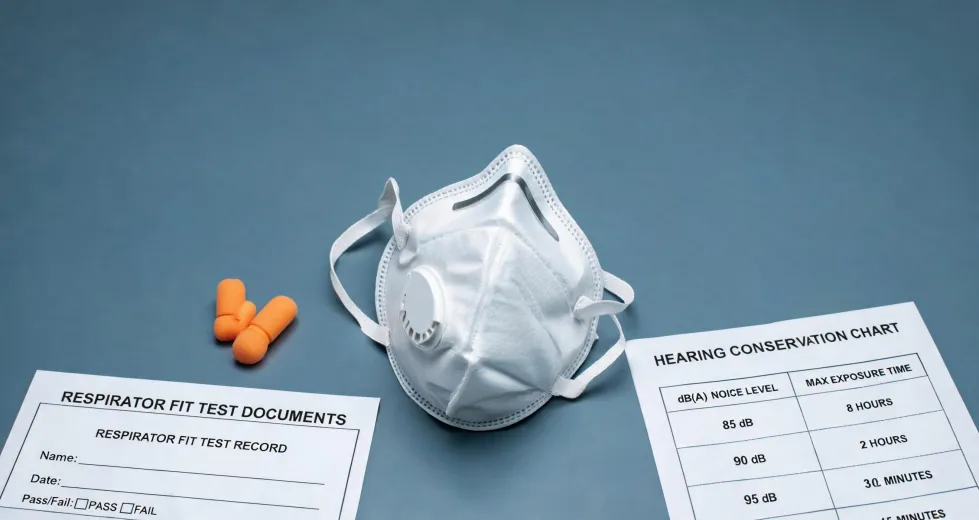
Hearing protection is where most people make a different kind of mistake. They buy cheap foam bullets and call it done. The problem? Workers remove them. They 'forget.' They shove them in wrong.
Moldex's Pura-Fit is a tapered foam earplug with an NRR of 33—about as high as you can get without going custom. The SparkPlugs are the same foam but with a detectable cord (great for food processing or flammable environments).
What surprised me: The Pura-Fit plugs are slightly larger than standard bullets. I expected complaints. Instead, users reported they sealed more comfortably. The trick was training—proper insertion technique dropped discomfort complaints by 70% in our Q2 2023 trial.
A Note on the "NRR 33" Claim
NRR 33 is the maximum rating under ANSI S3.19. In real-world conditions, derating factors apply (OSHA recommends 50% for foam). So 33 becomes ~16.5 in practice. That's still better than most plugs at 24–28, but don't assume 33 NRR = 33 dB protection on the floor.
“Reference: OSHA Technical Manual, Section III, Chapter 5. Derating is standard practice for hearing conservation programs.”
How to Know Which Scenario You're In
Here's the checklist I use now, after the $3,200 mistake and the closet full of rejected masks:
- What's the contaminant? Dry dust only? → N95. Oil, fumes, chemicals? → Half-mask + P100.
- How long are they wearing it? Under 2 hours? → Any N95 works. Full shift? → Get the valved version (Moldex 4600) or a half-mask.
- Any facial hair or wide faces? Yes? → Buy at least two mask sizes/models. Test fit with a proper OSHA protocol.
- Do you need hearing protection too? Yes? → Invest in NRR 33 plugs and a training session. Cheap plugs are a false economy.
I've caught 47 potential errors using this checklist over the past 18 months. It's not perfect. But it beats guessing.
The Bottom Line
Moldex makes solid gear. I use their products for our N95, P100, and earplug needs, and I've stopped looking for alternatives. But the gear is only half the equation. The other half is matching it to the person, the task, and the environment.
What was best practice in 2020 may not apply in 2025. The fundamentals haven't changed—fit, comfort, protection level—but the execution has. Don't buy for the spec sheet. Buy for the person wearing it.

Maeve Callahan
Maeve Callahan is a head-protection analyst covering Type I and Type II hard hats, climbing-style safety helmets, bump caps, chin straps, suspensions, liners, and face-shield carriers. She applies ANSI Z89.1, EN 397, and EN 12492 criteria while comparing impact attenuation, penetration resistance, lateral deformation, electrical class, retention strength, field of vision, mass, fit range, and temperature conditioning. Her guides help EHS teams, contractors, utilities, and buyers select helmet systems for overhead hazards, work at height, electrical exposure, accessory compatibility, and worker acceptance.