How to Order Moldex N95 Masks: A Practical Procurement Checklist
-
Step 1: Confirm the Protection Level You Actually Need
-
Step 2: Order the Right Sizes (Not Just "Standard" N95s)
-
Step 3: Verify NIOSH Approval Before You Buy
-
Step 4: Calculate Total Cost, Not Just Unit Price
-
Step 5: Source Smartly—Local vs. Online
-
Step 6: Audit Your Other PPE While You're At It
-
Step 7: Build Fit Testing Into the Same Order
-
Common Mistakes to Avoid
If you've just been told to "order some N95 masks" for your company, you've probably realized it's not as simple as adding a box to the cart. I've been managing PPE purchasing since 2020—roughly 60-80 orders a year across three locations—and I've made just about every mistake in the book. This checklist is the system I actually use for every Moldex N95 order, whether it's a 50-box reorder or a first-time purchase for a new facility.
Step 1: Confirm the Protection Level You Actually Need
This sounds basic, but it's the step that gets skipped more than any other. Before you search "moldex n95" online, check your OSHA hazard assessment. What are your people actually exposed to?
- N95 – filters at least 95% of airborne particles. The right choice for most general industrial settings: wood dust, silica dust, pollen, and other non-oil aerosols.
- P100 – filters 99.97% of particles. Better for welding fumes, lead dust, or oil-based aerosols.
- FFP2 – the European rating, roughly equivalent to N95. Relevant if you're buying for operations using EN-rated equipment.
Moldex covers all three, so you won't need to switch vendors. But it's on you to specify the right level. No sales rep or marketplace listing should be making that call for you.
Step 2: Order the Right Sizes (Not Just "Standard" N95s)
Here's the thing people get wrong: they order one size of N95 for the whole team. From the outside, it looks like "one size fits all" is fine for disposable respirators. The reality is, a respirator only protects you if it forms a proper seal. And a standard size does not seal properly on a large percentage of faces—especially smaller ones.
That's why Moldex N95 small exists. The Moldex 2200 series includes a small version that's NIOSH-approved. If you've got workers with smaller face profiles—which includes a lot of women and people of Asian descent—you need those smalls in the mix. I remember our quality control team (all women, all wearing standard-size masks) telling me the fit was off, and I ignored it for an entire reorder cycle. Then one of them did a quick fit test at home and showed me the gap on video. We reordered a mixed batch—30% small, 70% regular—and the fit complaints dropped to zero.
Step 3: Verify NIOSH Approval Before You Buy
I knew I should verify NIOSH certification before ordering from a new supplier once. But I figured, "it says N95 in the title, what are the odds it's fake?" The odds caught up with me. We received a pallet of "N95s" with a printed approval number that didn't exist in the CDC/NIOSH database. We had to quarantine everything and expedite a replacement order.
So now I do this without exception: look up the approval number on the NIOSH Certified Equipment List before I buy. The Moldex 2200 NIOSH N95, for instance, is NIOSH-approved with an approval number starting with TC-84A—the exact number is on the product page and in the CDC database. If a listing doesn't clearly show this number, I move on. Counterfeit and substandard respirators are still common enough that this step is non-negotiable.
Step 4: Calculate Total Cost, Not Just Unit Price
I can't emphasize this one enough. The cheapest price per mask is rarely the cheapest order overall. When I compare vendors, I factor in:
- Unit price (obviously)
- Freight and shipping costs
- Lead time—and the cost of waiting
- Minimum order quantities and whether they match your actual usage
- Return and replacement policies for defective items
- Fit-test implications if you're switching brands or models
Here's a real example. In 2022, our usual supplier quoted $1,200 for an urgent order and a new online vendor quoted $800. The $800 quote looked like a no-brainer. But after shipping ($120), a 9-day lead time (overtime cost: roughly $900), and re-fit testing for a new brand ($350 in labor), the "cheaper" option was actually $170 more expensive.
The $500 quote that arrives in two weeks can cost more than the $650 quote that arrives in three days. At least, that's been my experience after five years of managing these orders.
Step 5: Source Smartly—Local vs. Online
Searching "n95 mask near me" is my first move when something's urgent. Local safety suppliers are great for same-day pickup in a pinch. But for routine reorders, I've had better luck with online industrial distributors—Grainger, Zoro, or authorized Moldex dealers. They're usually cheaper and hold better stock.
The "local is always faster" thinking comes from an era before next-day logistics existed for commercial customers. Today, a well-organized online distributor can beat a local shop on both price and lead time. That said, when you need masks "yesterday," local is still king. It helps to have at least one local supplier relationship for emergencies—even if the routine orders go online.
One tip: check Moldex's own website for a list of authorized distributors. That's how you know you're getting genuine product with the manufacturer's warranty behind it, instead of a third-party marketplace listing that could be old stock or worse.
Step 6: Audit Your Other PPE While You're At It
This is the step most buyers miss, and I still kick myself when I skip it. You're already going through the work of placing a PPE order. Take five minutes to check what else is running low.
The specific question I get constantly: latex vs nitrile gloves—which one should you stock?
- Latex – cheaper and stretchy, with good comfort. But it's a potential allergen and breaks down in contact with oils and petroleum products. In industrial environments, that's a real limitation.
- Nitrile – costs a bit more per box. But it resists punctures much better, handles oils without breaking down, and is allergy-safe. For most B2B environments, nitrile is the right call.
If you're tempted to save on latex, run the total-cost numbers: allergic reactions, glove failures, mid-task changes, and lost worker minutes. That small per-box savings disappears fast. I switched our facilities to nitrile in 2021 and never looked back.
Step 7: Build Fit Testing Into the Same Order
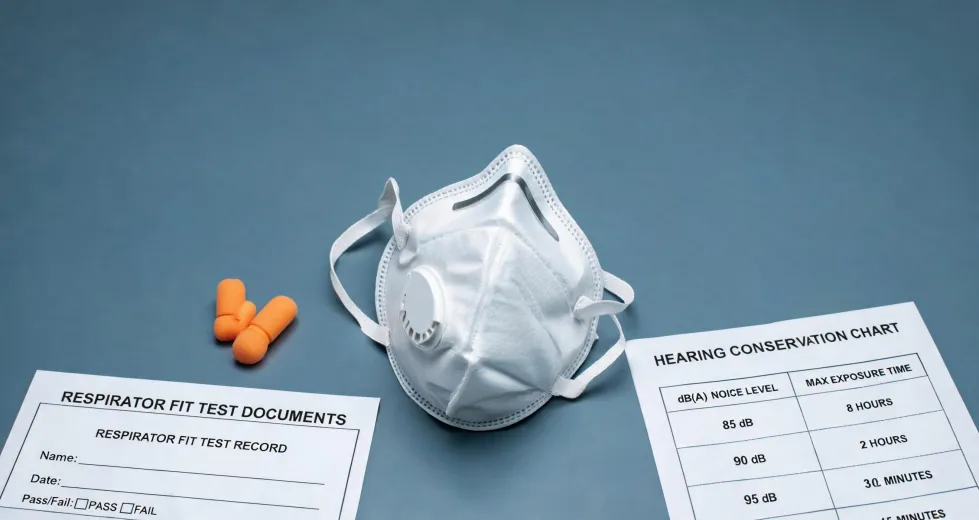
If you're issuing N95 respirators, OSHA's Respiratory Protection Standard (29 CFR 1910.134) requires fit testing. This is not optional, and it's not a paperwork exercise—it's how you know the respirator actually protects the person wearing it.
First-time buyers almost always skip this step, and it comes back to bite them during an audit or an incident investigation. Don't let that be you.
Here's what I do:
- Add fit test kits to the same purchase order as the masks
- Schedule fit tests for when the masks arrive—not "sometime next month"
- Keep a log of who was tested, with which model and size
- Retest on any mask model change
- Retest annually, or whenever an employee reports a bad seal
Common Mistakes to Avoid
- Ordering only one size. You'll need standard and small for most teams. Order at least 30% in small until you have data to adjust.
- Believing a listing that says "NIOSH Approved" without verifying. Look up the actual approval number. Fakes are everywhere.
- Comparing unit prices only. Shipping, lead time, minimums, and fit testing all affect the total cost.
- Not setting a reorder point. Nothing costs more than a "we're out" rush order. Set an inventory alert at 50% remaining, or you'll be paying next-day freight at the worst possible moment.
- Forgetting you're buying for real people. Face shapes, skin sensitivities, and preferences vary. A standard N95 is not the answer for every employee.
Every mistake on this list is one I've already made over the last five years. I can't promise your orders will go perfectly—mine still don't—but walking through this checklist has stopped me from repeating the ones that cost the most time and money.

Maeve Callahan
Maeve Callahan is a head-protection analyst covering Type I and Type II hard hats, climbing-style safety helmets, bump caps, chin straps, suspensions, liners, and face-shield carriers. She applies ANSI Z89.1, EN 397, and EN 12492 criteria while comparing impact attenuation, penetration resistance, lateral deformation, electrical class, retention strength, field of vision, mass, fit range, and temperature conditioning. Her guides help EHS teams, contractors, utilities, and buyers select helmet systems for overhead hazards, work at height, electrical exposure, accessory compatibility, and worker acceptance.