Your Safety Gear 'Defect' Is Probably One of Three Scenarios—Here's How to Tell Which
Three Complaints That All Sound the Same
I've been the quality and brand compliance manager at an industrial safety distributor for six years. I review roughly 150 product lines and their documentation packages every quarter before they reach customers. If I had a dollar for every time someone told me 'the product is defective' when the product was actually fine, I could retire early.
Here's what took me longer to learn than I'd like to admit: there's no single fix for safety equipment complaints. Honestly, what walks in the door as 'this thing is broken' usually falls into one of three buckets—and the right move is different for each.
- The gear matches the spec sheet but doesn't fit your actual situation.
- The equipment is reporting something real that nobody has checked yet.
- The paperwork and the product don't line up.
Figure out which one you're in before you call anyone. It'll save you a week.
Scenario A: The Gear Is Fine—It Just Doesn't Fit the Job
This is the most common one, and the hardest to accept because nobody wants to hear that they bought the wrong thing.
Take hearing protection. Most buyers focus on the NRR number printed on the box and completely miss whether the ear cup actually seals. NRR is measured under ANSI S3.19-1974 test conditions—a lab, a trained fitter, a controlled head. A 30 dB muff that leaks around the temple is worse than a 22 dB muff that seals. The number on the box is not the number in your ears.
The Honeywell R-01526 (from the Impact Sport line) is a good example of a product that gets misunderstood. It's an electronic earmuff: it amplifies low-level ambient sound and compresses impulsive noise above a threshold. People buy it for the shooting range, then complain it 'doesn't block enough' on a plant floor with continuous machinery noise. Or the reverse—they buy industrial muffs for a range day and can't hear range commands. That's not a defect. That's a product doing exactly what it was designed to do in a job it wasn't designed for.
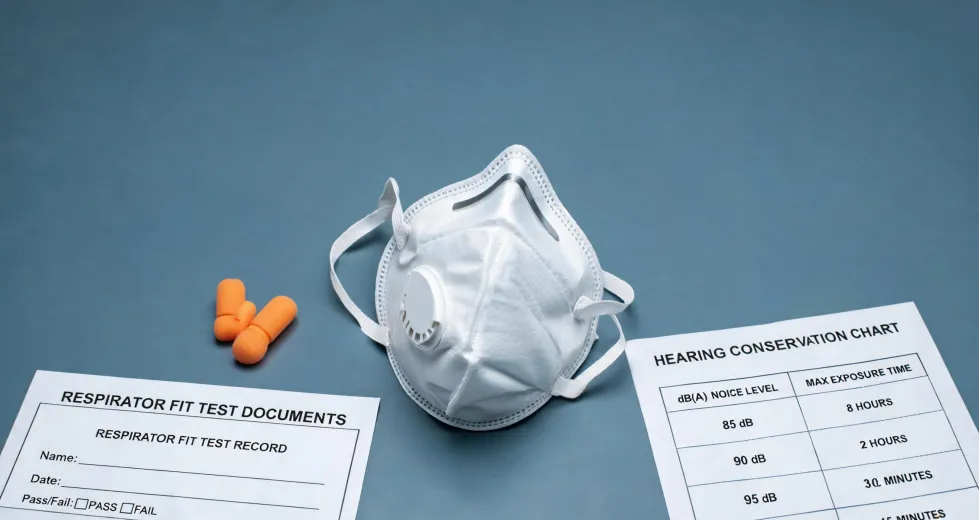
Which brings up something people get wrong constantly: they search for a 'Hearing Protection Act' and assume there's a federal statute by that name. There isn't. What they're usually looking for is OSHA's occupational noise standard, 29 CFR 1910.95, which sets the 85 dBA eight-hour exposure limit and requires a hearing conservation program above that. Worth knowing before you cite the wrong law in a procurement memo.
Same story with hard hats. ANSI Z89.1 covers the helmet, and a chin strap isn't a decorative accessory. It matters in three situations: high-wind areas, work where you're looking up or down repeatedly, and any task where a dropped helmet is itself a hazard. I skipped the chin strap inspection on a rental batch once because 'we've never had one fail.' That was the batch where two straps had UV-degraded to the point of crumbling. Three workers on a windy roof deck, one gust. We got lucky. Now the strap is on the checklist, not in my assumptions.
The fix: before you return anything, run a fit check and a task check. Does it seal, sit, or lock the way the manual describes when a person is actually wearing it? Is the environment continuous noise or impulsive noise? Putting the right product on the wrong face is still the wrong product.
Scenario B: The Alarm Is Telling You Something You Haven't Checked
From the outside, a fire alarm going off for no reason looks like a faulty detector. The reality is that most false alarms come from something the detector is correctly sensing—dust, steam, insects, a dying battery, or a sensor past its service life.
NFPA 72 recommends replacing smoke detectors every 10 years. If yours are older than that, the sensing element may have drifted out of calibration and you'll chase it forever. Kitchens, bathrooms, and laundry rooms trigger photoelectric units with steam on a schedule. A single spider walking across the chamber can set off a whole zone.
Here's where I draw my own line, and I think more facility managers should too. Cleaning a detector head or swapping a battery is a five-minute job you can do after reading the panel manual. Diagnosing a pattern of false alarms across a zone—or reconfiguring the detection logic—is not. That's licensed-technician work. A good one will tell you if the fix is more involved than you thought, and that honesty is worth more than a lower quote. I'd rather work with a specialist who knows their limits than a generalist who promises they can handle everything.
The fix: log the alarm times for two weeks. If they cluster around humidity, cooking, or a specific time of day, you have an environmental cause, not a hardware failure. If they're random across zones, get the panel history read by someone qualified.
Scenario C: The Paperwork Doesn't Match What's in the Box
The most common documentation mistake I see is pulling a Honeywell product manual for the wrong part number. Honeywell makes gas detectors with a dozen firmware revisions, and the manual for revision A doesn't always cover the wiring changes in revision C. Same with fire panels—a programming guide for one model will get you 80% of the way and then quietly lead you into a fault code that doesn't exist on your unit.
I rejected an entire first delivery in Q1 2024 because the spec sheet said IP66 and the nameplate said IP65. The vendor claimed 'within industry standard.' It wasn't. They redid the batch at their cost, and now every contract in that category includes a nameplate-versus-spec clause.
The fix: match the manual to the exact model and revision on the nameplate, not to the product family. If a supplier can't tell you which revision they're shipping, that's a red flag before the box ever opens.
How to Tell Which Scenario You're In
Ask yourself three questions in order:
- Does the complaint involve a person wearing or handling the item? If it's about fit, seal, or comfort on a body, you're in Scenario A. No amount of replacement units will fix a selection problem.
- Is the issue intermittent and reported by the system itself? Alarms, fault codes, and blinking panels are Scenario B until proven otherwise. Check environment and age before you check the hardware.
- Is there a mismatch between what the paperwork says and what the label or behavior shows? That's Scenario C, and it's usually resolved with a phone call and a revision number.
Most of the time you'll land in one of these before you finish the second question. The rest of the time, you have a real defect—and now you can describe it in a way the supplier's quality team will actually act on.

Mariko Sato
Mariko Sato is a workplace emergency-response equipment analyst covering industrial first-aid kits, AEDs, eyewash stations, emergency showers, burn kits, spill kits, bloodborne-pathogen kits, and fire extinguishers. She references ANSI Z308.1, ANSI/ISEA Z358.1, IEC 60601-2-4, and NFPA 10 while examining supply class, treatment capacity, activation time, flow rate, tepid-water delivery, shock energy, inspection interval, extinguisher rating, and placement distance. Her guides help EHS managers, facility teams, clinics, warehouses, and buyers plan equipment quantities, locations, maintenance, replenishment, responder access, and compatibility with site-specific emergency scenarios.