What an Emergency Pallet Fence Order Taught Me About N95 Fit Testing and Hearing Protection
-
The Pallet Fence and the Respirator Order That Caught Me Off Guard
-
The Pallet Fence That Made Me Rethink 'Just Find the Cheapest'
-
The Respirator Reality Check: N95 Is Not a Seal
- What Should You Consider When Choosing the Type of Hearing Protection You Use?
-
What I Learned: Certainty Is Worth the Extra Money
The Pallet Fence and the Respirator Order That Caught Me Off Guard
The email arrived on a Tuesday in March 2024. Our warehouse manager needed a pallet fence along the new racking aisle, and the safety committee wanted a fresh supply of N95 respirators before the spring maintenance shutdown. Two items. One purchase order. How hard could it be?
I have handled purchasing for our company since 2020. In a normal year, I process about 60 orders across eight vendors, and roughly $120,000 of that is safety-related. I learned a hard lesson in 2020, when a vendor with a great price couldn't provide a proper invoice, and finance rejected $2,400 worth of expenses. Since then, I verify the small stuff before I place an order. But PPE, respirators, and workplace noise were still outside my comfort zone.
If you have ever had to buy safety gear for a plant, you know the drill. The cheapest option is rarely the cheapest option.
The Pallet Fence That Made Me Rethink 'Just Find the Cheapest'
The pallet fence should have been the easy part. We needed a barrier for the pedestrian walkway next to the pallet racking. The warehouse manager sent me a specification: 96 inches long, yellow, with a load rating. 'If someone gets hit because we skipped a guardrail, that is on us,' he said.
I found a lower-cost supplier that could deliver in three to four weeks. Then the manager dropped the deadline: the safety audit was in ten days. The lower-cost supplier said 'probably' it would arrive in time. Probably is not a delivery date.
I had 48 hours to decide whether to pay an extra $250 for a supplier who would guarantee delivery in writing. Normally, I would get three quotes. There was no time. I went with the guarantee.
The upside was saving $250. The risk was showing the VP an unprotected aisle during a scheduled audit. I kept asking myself if $250 was worth the sleepless week. It was not.
In March 2024, we paid the extra money. The pallet fence arrived on time, and I started to understand the real difference between a quote and a promise.
The Respirator Reality Check: N95 Is Not a Seal
The respirators were a different kind of headache. I started by searching 'N95 respirator' and nearly ordered the cheapest box I could find from a brand I did not recognize. Then I called our safety consultant to ask about the spring maintenance crew. She asked if we had a respiratory protection program.
I said, 'We have respirators.' She laughed.
Here is something vendors will not tell you: N95 is a filter efficiency rating, not a face seal guarantee. It means the filter media captures at least 95% of certain airborne particles. But if air leaks in around the nose or cheeks, that percentage does not matter. Leakage bypasses the filter completely.
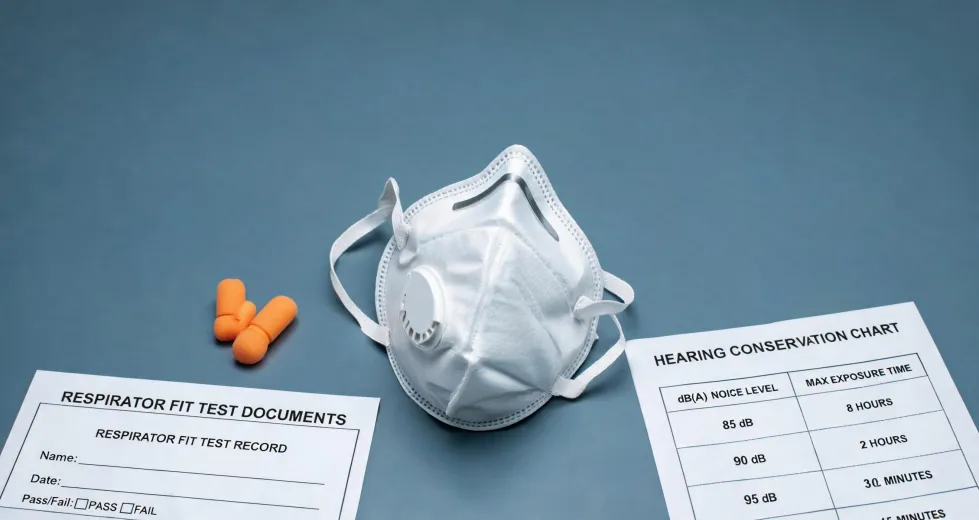
OSHA's respiratory protection standard (29 CFR 1910.134, as of January 2025) requires fit testing for tight-fitting respirators. Fit testing means checking that the respirator actually seals to a person's face. There is no one-size-fits-all face shape, and there is no shortcut around the test if you are in a regulated work environment.
We standardized on the Moldex 2200 N95 respirator. It is NIOSH-approved under 42 CFR Part 84, and it worked with the training our staff already knew. Then we bought the Moldex face fit testing kit so our safety coordinator could do in-house qualitative fit testing instead of waiting for an outside consultant's calendar.
The fit test kit costs more than a box of respirators, but it pays for itself quickly. Every new employee needs to be tested before wearing a respirator on the job. The alternative is telling a worker, 'Good enough,' and hoping the seal is good enough. I do not do that anymore.
What Should You Consider When Choosing the Type of Hearing Protection You Use?
The same purchase order ended up including hearing protection. Our machine shop had an annual noise survey, and the average shift came in around 88 dBA. That is above the 85 dBA action level in OSHA's occupational noise standard (29 CFR 1910.95), which means we have to provide a hearing conservation program and make sure people actually use the protection.
At first, I assumed the best approach was to buy the highest NRR and be done. I was wrong. People would pick the most extreme earmuffs, then take them off because their ears hurt or they could not hear the supervisor. Then we had no protection at all.
Here are the questions that actually matter when choosing hearing protection:
- Noise level. Measure it first. You need the TWA (time-weighted average) and an idea of peak exposure.
- NRR. The Noise Reduction Rating is lab-derived, so the real-world protection is lower. NRR 33 is high, but it only works if the earplug fits the individual ear.
- Compatibility. Do workers also wear hard hats, face shields, or respirators? The hearing protector has to work with all of it.
- Comfort and hygiene. Foam earplugs are disposable and simple. Reusable ones need cleaning. If it is uncomfortable, workers will 'forget' to use it.
- Communication. Over-protection can block alarms and instructions. The best protector is the one that gets worn consistently.
We ended up with Moldex foam earplugs with an NRR 33 rating. They were not the cheapest, but the crew stopped fighting us on them. A hearing protector you wear is more effective than one that hangs around your neck.
What Are Loop Earplugs?
The Loop earplugs question kept coming up, so let me answer it directly. Loop earplugs are consumer earplugs designed for concerts, sleep, and people dealing with noise sensitivity. They are small, often reusable, and they lower the volume of the world while still letting you talk.
They are fine for their purpose. But they are not industrial hearing protection. Occupational hearing protectors should carry an NRR label and be part of a hearing conservation program. Consumer earplugs like Loop are not a substitute for eight hours in a press brake area.
We made a simple rule: the production floor requires hearing protection that appears in our PPE matrix and has an NRR rating. Personal earbuds, Loop earplugs, and even earbuds under earmuffs do not count.
What I Learned: Certainty Is Worth the Extra Money
The pallet fence arrived on the Tuesday before the audit. The Moldex 2200 N95 respirators and the face fit testing kit arrived the same afternoon. The earplugs were already in the machine shop by Friday.
Walking the floor during the audit, I finally understood what people mean when they say safety is an investment, not an expense. The extra $250 for the pallet fence, the standardizing on a known N95 model, the in-house fit test kit, the NRR 33 earplugs, the disposable foam that people did not fight us on—all of it bought certainty.
Certainty that the fence would be installed before the audit. Certainty that the respirators would fit. Certainty that the hearing protection would actually be worn.
People think expensive safety equipment is what costs more. Actually, the equipment that gets worn and passes audits is what ends up being cheap. The $200 I almost saved on an unknown respirator would have been worthless if a worker failed a fit test or an auditor flagged our program.
Now I budget for guaranteed delivery and proper fit testing. I keep a spare Moldex face fit testing kit in the inventory room, and my annual PPE plan includes a line item for replacement kits and new employee fit tests. The worst thing I can do to a warehouse manager is say, 'Maybe it will arrive on time.'
(Note to self: order the next face fit testing kit before the onboarding wave in May.)
Take it from someone who now triple-checks delivery dates: if a supplier will not put a date in writing, that is a red flag. In a real emergency, the cheapest option and the right option are rarely the same thing.

Maeve Callahan
Maeve Callahan is a head-protection analyst covering Type I and Type II hard hats, climbing-style safety helmets, bump caps, chin straps, suspensions, liners, and face-shield carriers. She applies ANSI Z89.1, EN 397, and EN 12492 criteria while comparing impact attenuation, penetration resistance, lateral deformation, electrical class, retention strength, field of vision, mass, fit range, and temperature conditioning. Her guides help EHS teams, contractors, utilities, and buyers select helmet systems for overhead hazards, work at height, electrical exposure, accessory compatibility, and worker acceptance.