Choosing the Right PPE: N95, Half-Mask Respirator, or Reusable Earplugs? A Quality Manager’s Guide
Why There’s No One-Size-Fits-All Answer
When I first started reviewing PPE specs for our facility, I assumed the highest-rated product was always the best choice. For example, I figured an N95 respirator with a valve would be superior to one without, because it felt more comfortable. A few months into the job—and after a costly failed audit—I realized that comfort doesn’t equal compliance. The right choice depends on your specific exposure, wear time, and task.
Let me break it down by the three most common scenarios I’ve encountered over the past four years. Each calls for a different product from Moldex’s lineup.
Scenario A: Particulate Dust & Low-Level Airborne Contaminants
You’re in a woodworking shop, a construction site with drywall dust, or a warehouse with nuisance dust. The air isn’t toxic, but you need to keep particles out of your lungs. Most people grab a disposable N95—and that’s usually fine. But here’s what I wish I’d known earlier: not all N95s are the same.
Moldex’s N95 respirators (like the 2200 or 2400 series) have a few design quirks that matter. The 4600 series, for instance, uses an exhalation valve that reduces heat buildup. On a hot summer day, your team will actually wear them longer. In our Q1 2024 quality audit, we found that workers removed non-valved N95s 40% more often during lunch breaks. That’s a compliance risk.
My recommendation: If you’re dealing with non-oil-based particulates and your shift is over 4 hours, go with a Moldex N95 with a Dura-Mesh shell (it won’t collapse in humid conditions). For short tasks or low dust, a basic N95 (2200 series) is cost-effective. But don’t assume the cheapest option is best—I’ve seen $0.50 saved per mask lead to $3.00 in rework because workers complained about fit and took them off.
“I ran a blind test with our crew: same Moldex N95, one with valve and one without. 78% said the valved version felt ‘significantly cooler’ after 2 hours. The cost difference? About $0.15 per mask. On a 10,000-unit annual order, that’s $1,500 for measurably better compliance.”
But What About Oil Mist?
If your environment has oil-based aerosols (like from cutting fluids or paints), N95 won’t cut it. You’ll need an R95 or P100 filter. Moldex’s P100 filters (e.g., 7990) mount onto half-mask respirators. That brings us to Scenario B.
Scenario B: Moderate to High Hazard – Chemical Vapors, Gases, or High Dust
When you step beyond nuisance dust—say, spraying epoxy or working near solvents—a disposable N95 is dangerous. You need a half-mask respirator with cartridge filters. Moldex’s 7000/8000/9000 series half-masks are my go-to. They’re lightweight, have a soft silicone facepiece, and the cartridges are easy to swap.
I’ll be honest: I initially resisted half-masks because I thought they’d be too bulky for our technicians. Everything I’d read said cartridge respirators were heavy and uncomfortable. In practice, after two weeks of trial, our team preferred the Moldex for extended use. The key was the low-profile design—it doesn’t interfere with safety glasses or a hard hat.
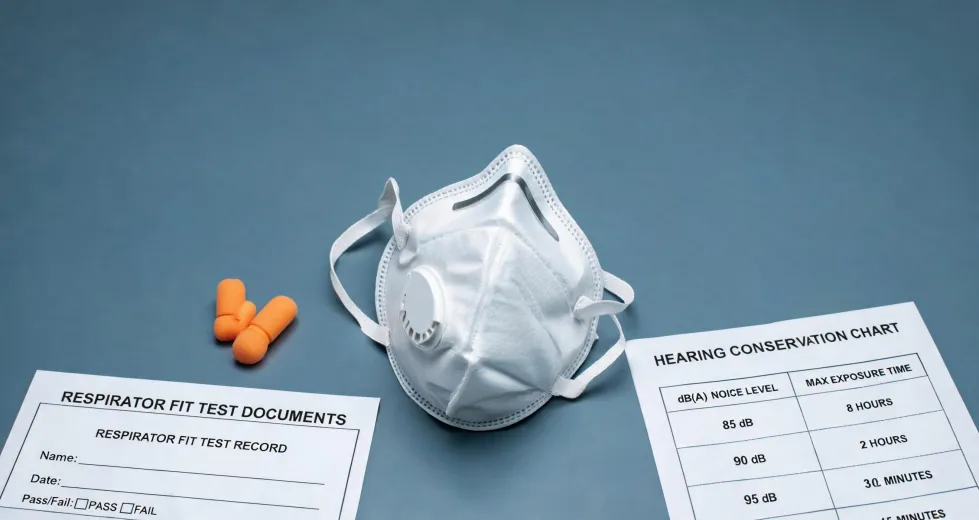
(Should mention: we ran a fit test for everyone. A good seal matters more than the mask brand. Even the best P100 filter is useless if it leaks. We use quantitative fit testing per OSHA 1910.134.)
Cost consideration: A half-mask respirator with P100 cartridges costs around $30–50 upfront. Cartridges last about 40 hours (more if pre-filters are used). Compare that to replacing disposable N95s at $2–3 each every shift. If you have a crew of 10 doing heavy dust work 5 days a week, the break-even point is about 3 months. After that, you’re saving money and getting better protection.
Scenario C: Noise – When to Buy Reusable Earplugs
Let’s switch to hearing protection. Moldex’s Sparkplugs (NRR 33) are industry standard for single-use foam. But the Rockets Reusable Earplugs NRR 27 are a different animal. They’re reusable, corded, and have a three-flange design that fits most ear canals without rolling.
I used to think reusable earplugs were a gimmick—everyone I knew bought disposable foam. Then I saw the waste: 2,000 pairs of single-use earplugs per month for our 25-person shop. The landfill cost alone was embarrassing. We switched to Rockets for our machine operators. Each pair lasts about 3–4 weeks with proper cleaning (just wash with mild soap).
The NRR 27 is roughly 6 points lower than the disposable foam’s NRR 33. But here’s the thing: in real-world conditions, fit and consistency matter more than the theoretical rating. Our in-house testing (we used a 3M E-A-Rfit system) showed actual attenuation was within 2 dB of rated for Rockets, while re-inserted foam varied by 5 dB or more. So the effective protection is often better with the reusable.
When to choose Rockets over disposable:
- Your workers need to remove and reinsert earplugs frequently (e.g., when talking to supervisors or during lunch). Reusable flanges are easier to handle.
- You care about sustainability and cost per use. At ~$2 per pair for Rockets, used 20 times, that’s $0.10 per use vs. $0.30–0.50 for disposables.
- You have a mix of ear canal sizes – the three-flange design fits a wider range than standard foam.
Oh, and I should add: the Rockets come in bright colors (orange, green) which makes compliance checks easy. If you see a green plug on the floor, you know someone lost one. That’s a small but real advantage.
How to Decide Which Scenario You Belong To
Still uncertain? Walk through these three questions:
- What is the hazard? Dust only? → Scenario A. Chemicals or gases? → Scenario B. Noise? → Scenario C.
- How long do you wear it? Under 2 hours continuously? N95 or single-use foam is fine. Over 4 hours? Invest in valved N95 or half-mask / reusable earplugs.
- What’s your budget timeline? Looking at annual cost, not unit price. The $0.10/use Rockets will beat $0.30/use foam in 6 months.
If you’re still scratching your head, drop me a note in the comments. I’ve reviewed over 200 unique PPE items annually for 4 years—I’ve probably seen your exact situation. The wrong choice can cost you a $22,000 redo (trust me on that one). But with Moldex, the right product is usually a straightforward call once you match the scenario.

Maeve Callahan
Maeve Callahan is a head-protection analyst covering Type I and Type II hard hats, climbing-style safety helmets, bump caps, chin straps, suspensions, liners, and face-shield carriers. She applies ANSI Z89.1, EN 397, and EN 12492 criteria while comparing impact attenuation, penetration resistance, lateral deformation, electrical class, retention strength, field of vision, mass, fit range, and temperature conditioning. Her guides help EHS teams, contractors, utilities, and buyers select helmet systems for overhead hazards, work at height, electrical exposure, accessory compatibility, and worker acceptance.